Table of Contents
Troubleshooting

Related Manuals for Wood-mizer LX250


Summary of Contents for Wood-mizer LX250
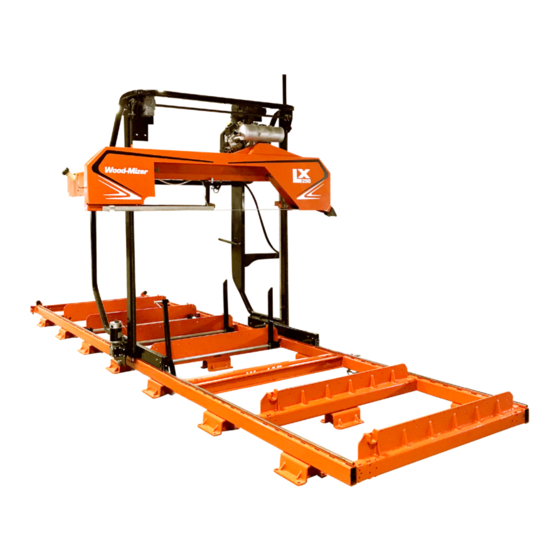
- Page 1 ® LX250 Wood-Mizer Sawmill Safety, Setup, Operation & Maintenance Manual LX250 rev. A2.01 Safety is our #1 concern! Read and understand all safety information and instructions before oper- ating, setting up or maintaining this machine. Form #2370...
- Page 2 Active Patents assigned to Wood-Mizer, LLC Wood-Mizer, LLC has received patents that protect our inventions which are a result of a dedication to research, innovation, development, and design. Learn more at: woodmizer.com/patents ©2020 Wood-Mizer LLC Printed in the United States of America, all rights reserved. No part of this manual may be reproduced in any form by...
-
Page 3: Table Of Contents
SECTION 1 INTRODUCTION About This Manual.................1-1 Getting Service ..................1-1 Specifications ..................1-1 Customer and Sawmill Identification.............1-1 Specifications ..................1-2 LX250 Dimensions ................. 1-3 SECTION 1 GENERAL SAFETY Safety Symbols..................2-1 Safety Instructions ..................2-1 Observe ALL Safety Instructions............2-1 Electrical Lockout Procedures..............2-3 SECTION 3 SAWMILL ASSEMBLY Tools required..................3-1... - Page 4 Blade Wheel Alignment ................ 9-11 Blade Guide Re-installation..............9-14 Blade Guide Arm Alignment ..............9-15 Blade Guide Deflection ................ 9-18 Blade Guide Vertical Tilt Alignment............ 9-19 Blade Guide Flange Spacing ............... 9-21 Blade Height Scale Adjustment............9-22 LX250 4/16/21 Table of Contents...
- Page 5 Limited Product Warranty Wood-Mizer LLC (“Warrantor”), an Indiana corporation with its principal place of business at 8180 West Tenth Street, Indianapolis, IN 46214-2400 USA, warrants to the purchaser (“Purchaser”) that for the time periods specifically stated herein and subject to the terms, conditions and limitations stated herein, the equipment manufactured by the Warrantor will be free from defects in material and workmanship attributable to Warrantor so long as, during the warranty periods stated herein, the equipment is installed, operated and maintained in accordance with the instructions provided by Warrantor.
-
Page 6: Introduction
Customer and Sawmill Identification Each Wood-Mizer sawmill is identified with a model number, revision, and serial number (see the figure below). M FG B Y / FA B R IQ U É PA R : W O O D -M IZ ER P R O D U C TS , IN C . 8 18 0 W. 1 0th St. Ind ian ap olis , 4 62 1 4 -2 40 0 U .S .A . - Page 7 Specifications Specifications Model: LX250 Rev. A1.00+ Dimensions: 18’-2.5” Length: 5’-3.25” Bed width: 9'-2.12" Unit width: 8'-6.67" Height (Ground To Mast): 9'-9.75" Height (Max Head Position): Blade: .042 x 1¼ x ; 10° Weights (Actual/Estimated): Basic Unit : 2960 lbs Shipping weight:...
-
Page 8: Lx250 Dimensions
LX250 Dimensions LX250 Dimensions LX25018-1 WM doc 4/16/21... - Page 9 LX250 Dimensions LX25018-2 WM doc 4/16/21...
-
Page 10: General Safety
Safety Instructions Do not use flammable fuels or liquids such as diesel OWNER/OPERATOR'S RESPONSIBILITY fuel. Use ONLY water and Wood-Mizer Lube Additive with the water lube accessory. The procedures listed in this manual may not include all ANSI, OSHA, or locally required safety procedures. It is the MILL SETUP owner/operator’s responsibility and not Wood-Mizer LLC... - Page 11 General Safety Observe ALL Safety Instructions DISPOSE OF WOOD BY-PRODUCTS PROPERLY Disengage the blade and shut off the sawmill engine before changing the blade. NOTICE Properly dispose of all wood by-products, WARNING! Avoid contact with any hot parts including sawdust, chips, and other debris, including (motors).
-
Page 12: Electrical Lockout Procedures
General Safety Electrical Lockout Procedures Electrical Lockout Procedures GENERAL The following simple lockout procedure is provided to assist RULES FOR USING LOCKOUT PROCEDURE owner/operators in developing their procedures so they meet the requirements of OSHA regulation 1910.147. When the The equipment shall be locked out to protect against acciden- energy isolating devices are not lockable, tagout may be tal or inadvertent operation when such operation could cause used, provided the owner/operator complies with the provi-... - Page 13 General Safety Electrical Lockout Procedures CAUTION! Verify that the controls are in neutral. Return operating control(s) to neutral or "off" position after verifying the isolation of the equip- Remove the lockout devices and re-energize the machine or ment. equipment. The machine or equipment is now locked out. NOTE: The removal of some forms of blocking may RESTORING EQUIPMENT TO SERVICE...
-
Page 14: Sawmill Assembly
Sawmill Assembly Tools required SECTION 3 SAWMILL ASSEMBLY CAREFUL PLANNING IS ESSENTIAL TO A SMOOTH ASSEMBLY. READ THIS SECTION THOROUGHLY TO PLAN THE ASSEMBLY. NOTICE: Do not unbolt all the shipping brackets at once. Remove the shipping brackets securing the sawmill to the pallet at each step to pre- vent inadvertent shifting of the parts. - Page 15 Sawmill Assembly Uncrating the mill See Figure 3-1. NOTICE: Do not catch wires between lifting strap and frame. Three point attachment LX25018-09 TOP VIEW FIG. 3-1 NOTICE: Raise the saw head slowly to adjust for load shift. The saw head is heavier on the engine side. 4.
- Page 16 End Stop Left 015721 Tensioner Wldmt, Power Feed Chain (on End Stops) 128014 Bed Shim, LX250 16Ga 128015 Bed Shim, LX250 16Ga 128016 Bed Shim, LX250 7Ga The Power Feed motors and one motor mount are packaged separately. The second Power Feed motor mount is bolted on the exterior of the bed frame sections.
-
Page 17: Assemble The Bed
Sawmill Assembly Assemble the bed See Figure 3-4. LX25015-3 FIG. 3-4 The manual bag, located inside the saw head cover, also includes a belt tension gauge (016309) and a Blade Guide Alignment Tool (LTBGAT). See Figure 3-5. 016309 LTBGAT FIG. 3-5 Assemble the bed Area must be firm and level. - Page 18 Sawmill Assembly Assemble the bed Allow maneuvering room for operators, sawdust removal, log loading, and board removal. NOTICE: Observe the direction of the alignment pins in relation to the remaining bed sections. Plan the assembly such that the log supports are on the same side as the operator’s station, and such that the section without a log support is at the head of the log bed.
- Page 19 Sawmill Assembly Assemble the bed See Figure 3-6. Center section Foot section Head section FIG. 3-6 5. Loosely attach 3 bed feet while the bed is suspended. See Figure 3-7. Bed Head Center section Bed Foot LX25023 FIG. 3-7 6. Set the bed section on its feet. 7.
- Page 20 Sawmill Assembly Assemble the bed CONNECT BED SECTIONS 8. Align the rail pins. 9. Draw the bed sections together and secure with fasteners from the hardware bag. See Fig. 3-8. NOTE: If necessary to draw the bed segments tightly together, use a large C-clamp, a rubber mallet, or a sledge hammer with a wooden block.
- Page 21 Sawmill Assembly Assemble the bed See Figure 3-9. Rail fits tight Frame gap FIG. 3-9 10. Recheck that the rail joints are tight and smooth. 11. Tighten the bed section bolts. 12. Level the bed sections as you go. See Figure 3-10. LX25018-5 FIG.
-
Page 22: End Stop Assemblies
Sawmill Assembly End Stop Assemblies See Figure 3-11. Shim LX25018-3 FIG. 3-11 14. Repeat steps 2 through step 13 for the last bed section. End Stop Assemblies NOTICE: The end stops (bumpers) are left/right oriented. 1. Mount the end stops to the frame with the shims between the frame and the end stops. See Figure 3-12. -
Page 23: Saw Carriage Assembly
Sawmill Assembly Saw Carriage Assembly 1. Adjust the frame legs so the sawmill appears level; use shims under the legs, if neces- sary. See Figure 3-13. Measure the distance between the string and the bed rails Matching Spacer LX25018-17 String Matching Spacer FIG. -
Page 24: Feed Drive Assembly
Sawmill Assembly Feed Drive Assembly NOTE: There should be no more than an 1/8” clearance between the mast safety assembly and the bed rail. 5. Ensure the white rail wipers make firm contact with the rails: the wiper mounting plate should not set on the rail. - Page 25 Sawmill Assembly Feed Drive Assembly See Figure 3-15. LX25018-15 FIG. 3-15 3. Assemble the Power Feed mount (without cover) as shown in Fig 3-16. See Figure 3-16. T Drive chain Bolts, washers, and nuts shipped in place. Mount Power Feed Cover Mount LX25018-14...
- Page 26 Sawmill Assembly Feed Drive Assembly NOTE: Catch the drive sprocket in the drive chain while mounting. It will be difficult to attach after the motor is in place. See Figure 3-17. LX25018-16 FIG. 3-17 6. Slide the drive assembly in the mounting slots until the all loose slack in the drive chain has been taken up.
- Page 27 Sawmill Assembly Feed Drive Assembly See Figure 3-18. Green Blue Blue Green RIGHT LEFT MOTOR MOTOR LX25024 FIG. 3-18 e. Tighten the nuts. f. Slide the protective caps over the terminals. 9. Install the Mount Cover. (See Fig. 3-16.) 10. Repeat steps 2 through 9 for the other side. Sawmill Assembly WMdoc122320 3-14...
-
Page 28: Sawmill Setup
Sawmill Setup Installing the Blade SECTION 4 SAWMILL SETUP The following setup procedure should be performed whenever the sawmill is moved or reassembled. If sawing problems occur and misalignment is suspected, See Section SECTION 8 for complete alignment instructions. See Section SECTION 8 for sawmill assembly instructions. - Page 29 Sawmill Setup Installing the Blade See Figure 4-1. Tensioner handle (storage area) Tensioner handle LX1501-04 FIG. 4-1 3. Place the new blade around the blade wheels. NOTE: When installing a blade, make sure the teeth are pointing the correct direction. The teeth should be pointing toward the operator side of the mill when you are looking at the blade below the blade guides.
-
Page 30: Tensioning The Blade
Sawmill Setup Tensioning The Blade Tensioning The Blade 1. Use the supplied handle to turn the tensioner handle clockwise until the tension gauge indicates 1500-1700 PSI tension. See Figure 4-2. Tensioner handle (storage area) Tension gauge Normal operation: 1500-1700 PSI Tensioner handle LX1501-04 FIG. - Page 31 Sawmill Setup Tracking The Blade 1. Ensure the blade housing cover is closed and all persons are clear of the open side of the saw head. DANGER! Always be sure the blade is disengaged and all persons are out of the path of the blade before starting the engine or motor. Failure to follow this will result in serious injury WARNING! Make sure all guards and covers are in place and secured...
- Page 32 Sawmill Setup Tracking The Blade See Figure 4-4. Cant Control LX1501-07 FIG. 4-4 7. Position 1 1/4” wide blades so the gullet is 1/8" (3.0 mm) out from the edge of the blade wheel (±1/32 [.75 mm]). See Figure 4-5. 150060 1/8”...
-
Page 33: Sawblade
Sawmill Setup Sawblade WARNING! Make sure all guards and covers are in place and secured before operating the sawmill. Failure to follow this may result in serious injury or death. NOTICE: After aligning the blade on the wheels, always double-check the blade guide spacing and location. -
Page 34: Blade Guide Flange Spacing
Sawmill Setup Blade Guide Flange Spacing 7. Measure the distance from the bed rail to the bottom edge of the tool. 8. If the measurement from the tool to the bed rail is not equal within 1/32" (.75 mm), adjust the vertical tilt of the outer blade guide roller. - Page 35 Sawmill Setup Blade Guide Flange Spacing The blade guide rollers should also be slightly cocked. If the moving blade makes contact with the leading flange edge of the roller, momentum may cause the blade to slip over the flange. Contact with the trailing edge would force the blade upward onto the roller. NOTICE: When adjusting blade guide spacing, loosen the top set screw and one side set screw only.
-
Page 36: Starting The Engine
Sawmill Setup Starting The Engine INNER BLADE GUIDE 6. Ensure that the distance between the flange on the inner blade guide roller to the back edge of the blade measures to 1/16" (1.5 mm). See Figure 4-8. 7. Adjust the roller back or forward, as described above. Starting The Engine DANGER! Always be sure the blade is disengaged and all persons are... -
Page 37: Sawmill Operation
Sawmill Operation Manual Power Feed SECTION 5 SAWMILL OPERATION Manual Power Feed The power feed system moves the mast forward and backward by using the two switches on the control panel illustrated below. See Figure 5-1. Fast Slow Forward Reverse Drum Switch Handle LX0017-2... - Page 38 Sawmill Operation Manual Power Feed MAST FEED RATE The mast feed rate switch controls the speed at which the mast travels forward. Turn the switch clockwise to increase speed. Turn it counterclockwise to reduce speed. USING THE POWER FEED 1. Use the forward/reverse drum switch and the feed rate switch to position the sawhead for the cut.
-
Page 39: Manual Up/Down Operation
Sawmill Operation Manual Up/Down Operation Manual Up/Down Operation CAUTION! Ensure the blade is properly installed and tensioned before moving the sawhead. 1. Use the up/down drum switch located on the right side of the control panel to raise or lower the cutting head. 2. -
Page 40: Changing The Default Setup
Sawmill Operation Changing the Default Setup See Figure 5-3. Display area FIG. 5-3 Changing the Default Setup Simple Set is factory set. To change the default settings, hold down the Manual button and use the Scroll Up button to enter the Setup Menu. Use the Auto button to move between setup criteria. -
Page 41: Operation
Sawmill Operation Operation Exit Setup by using the Manual button. Operation MANUAL OPERATION 1. Select the Manual button, if not already in manual mode by default. 2. Refer to Manual Up/Down operation (previous section) for operation. NOTE: The display will show a ‘D’ when the drum switch is pushed down and a ‘U’... -
Page 42: Loading, Turning, & Clamping Logs
Sawmill Operation Loading, Turning, & Clamping Logs Loading, Turning, & Clamping Logs LOADING LOGS 1. Move the saw mast to the front end of the frame. CAUTION! Be sure the log clamps are adjusted out of the path of the log before loading a log onto the bed. - Page 43 Sawmill Operation Loading, Turning, & Clamping Logs See Figure 5-5. Locking handle LX1503-04 FIG. 5-5 LEVELING A TAPERED LOG Use shims or the wedge to raise either end of a tapered log until the heart of the log mea- sures the same distance from the bed rails at each end of the log. See Figure 5-6.
-
Page 44: Blade Guide Arm Operation
Sawmill Operation Blade Guide Arm Operation TURNING THE LOG CAUTION! Do not turn the log while on the log bed. Damage to the log bed may result. Use a forklift to lift the log off of log bed. Once off of the log bed, it can be turned and replaced in the new orientation. -
Page 45: Cutting The Log
Sawmill Operation Cutting The Log Cutting The Log 1. Once the log is placed where you want it and clamped firmly, move the saw head to posi- tion the blade close to the end of the log. 2. Use the blade height scale to determine where to make your first cut (See Section 5.8). -
Page 46: Edging
Sawmill Operation Edging 13. Repeat the steps used to cut the first side of the log until the log is square. Cut boards from the remaining cant by adjusting the blade height for the thickness of boards that you want. NOTICE: Remember that the blade cuts a 1/16 - 1/8"... -
Page 47: Blade Height Scale
Sawmill Operation Blade Height Scale Blade Height Scale See Figure 5-8. LX1501-21 FIG. 5-8 THE INCH SCALE The horizontal line on the blade height indicator shows how many inches the bottom of the blade is above the bed of the mill. If you know the height of your blade at each cut, you can determine the thickness of lumber you are sawing. -
Page 48: Water Lube Operation
Sawmill Operation Water Lube Operation 1 1/4" (32 mm) 1 1/2" (38 mm) 2" (51 mm) TABLE 5-1 To use the quarter scale, look at the blade height indicator. Position the magnetic quarter scale over the inch scale. Align one of the quarter scale marks with the horizontal line on the indicator. -
Page 49: 5.10 Transporting The Sawmill
This will clean the blade of sap buildup. Dry blade with a rag before storing or sharpening. For lubrication benefits, add one 12oz. (0.35L) bottle of Wood-Mizer Lube Additive to 5 gallons (18.9 liters) of water. Wood-Mizer Lube Additive enables some previously impos- sible timbers to be cut by significantly reducing resin buildup on the blade. -
Page 50: Maintenance
Maintenance Wear Life SECTION 6 MAINTENANCE WARNING! Turn the key switch to the OFF (0) position and remove the key before performing service near moving parts such as blades, pulleys, motors, belts, and chains. If the key is turned on and moving parts activated, serious injury or death may result. -
Page 51: Changing The Blade
Maintenance Changing The Blade Changing The Blade WARNING! Turn the key switch to the OFF (0) position and remove the key before performing service near moving parts such as blades, pulleys, motors, belts, and chains. If the key is turned on and moving parts activated, serious injury or death may result. -
Page 52: Sawdust Removal
Maintenance Sawdust Removal When installing a blade, make sure the teeth are pointing toward the operator side of the mill when you are looking at the blade below the blade guides. 4. Position 1 1/4” wide blades (standard) on the wheels so the gullet is 1/8" (3.0 mm) out from the edge of the wheel. -
Page 53: Mast Track, Wipers, & Scrapers
Maintenance Mast Track, Wipers, & Scrapers WARNING! Ensure the steel fingers inside the sawdust chute are in place before operating the sawmill. Failure to have these fingers in place may result in serious injury or death. The steel fingers have been designed to help prevent a broken blade or some other object from becoming a projectile and exiting the saw- dust chute. -
Page 54: Vertical Mast Rails
Maintenance Vertical Mast Rails See Figure 6-3. Track scraper LX2501 FIG. 6-3 Vertical Mast Rails WARNING! Turn the key switch to the OFF (0) position and remove the key before performing service near moving parts such as blades, pulleys, motors, belts, and chains. If the key is turned on and moving parts activated, serious injury or death may result. -
Page 55: Drive Belt Adjustment
Remove sawdust and dirt covering warning decals. Replace any damaged or unreadable decals immediately. Order decals from your Customer Service Representative. 5. Replace the idle blade wheel belt as necessary. (Use only belts supplied by Wood-Mizer.) Drive Belt Adjustment WARNING! - Page 56 Maintenance Drive Belt Adjustment 5. Add 1/2" (12.5mm) to that measurement and reset the large o-ring to the belt cover + 1/2" (12.5mm) setting. 6. Press down on the rubber boot; stop pressing when the large o-ring meets the edge of the belt cover. 8 lbs.
-
Page 57: Up/Down System
Maintenance Up/Down System See Figure 6-5. Adjustment nuts LX250-02 FIG. 6-5 Up/Down System WARNING! Turn the key switch to the OFF (0) position and remove the key before performing service near moving parts such as blades, pulleys, motors, belts, and chains. If the key is turned on and moving parts activated, serious injury or death may result. -
Page 58: 6.10 Charging The Battery
Maintenance Charging The Battery See Figure 6-6. LX15041-07 FIG. 6-6 6.10 Charging The Battery WARNING! Turn the key switch to the OFF (0) position and remove the key before performing service near moving parts such as blades, pulleys, motors, belts, and chains. If the key is turned on and moving parts activated, serious injury or death may result. - Page 59 Maintenance Charging The Battery NOTICE: When working with batteries, use extreme care to avoid spill- ing or splashing electrolyte (dilute sulfuric acid) as it can destroy cloth- ing and burn the skin. EMERGENCY TREATMENT FOR CONTACT WITH BATTERY COMPONENTS (LEAD/SUL- FURIC ACID) per SDS (Safety Data Sheet): EYE CONTACT Sulfuric Acid and Lead: Flush eyes immediately with large amounts of...
- Page 60 Maintenance Charging The Battery are intended to quickly charge a good battery that is discharged. They are not intended for unattended or long-term charging. 7. After the battery is completely recharged, remove the negative charger/jumper cable from ground. 8. Remove the positive charger/jumper cable from the battery. 9.
-
Page 61: Troubleshooting Guide
Troubleshooting Guide Sawing Problems SECTION 7 TROUBLESHOOTING GUIDE Sawing Problems WARNING! Turn the key switch to the OFF (0) position and remove the key before performing service near moving parts such as blades, pulleys, motors, belts, and chains. If the key is turned on and moving parts activated, serious injury or death may result. - Page 62 Troubleshooting Guide Sawing Problems PROBLEM CAUSE SOLUTION Height adjustment jumps or Up/down chain improperly Adjust up/down chain. stutters when moving up or adjusted. down. Vertical wear pads are too Adjust pads. tight. Lumber is not square Vertical side supports not Adjust side supports.
-
Page 63: Simple Set Troubleshooting
Simple Set Troubleshooting Simple Set Troubleshooting Error Messages See Table 8-1. Simple Set error messages. Error Description E02 Sensor This message is displayed if Simple Set cannot detect the encoder sensor mag- net when entering auto mode. Check that the gear box extension is aligned with the sensor. -
Page 64: Simple Set Up/Down Gear Settings Adjustment
Simple Set Up/Down Gear Settings Adjustment NORMAL OPERATION: As the up/down gearbox shaft spins to move the saw head up or down, the sensor LED will illuminate and brighten. After each complete revolution of the shaft, the LED will turn off, then illuminate and brighten. -
Page 65: Simple Set Pid Settings
Simple Set PID Settings See Figure 8-2. Display Scroll Up/Down Manual Auto 3H1128 FIG. 8-2 4. Press the Auto button several times until "Gear: 0.xxxx" appears. 5. Use the Up /Down buttons to set the value of the Gear Setting as shown in the table below. - Page 66 Simple Set PID Settings 3. Release the Manual button, then release the UP button. The Simple Set control panel will display the Speed setting. See Figure 8-3. Display Scroll Up/Down Manual Auto 3H1128 FIG. 8-3 4. Press the Auto button several times until PGain, DGain and IGain settings appear. Use the Up /Down buttons to set the settings to the required values.
-
Page 67: Sawmill Alignment
Sawmill Alignment Routine Alignment Procedure SECTION 9 SAWMILL ALIGNMENT Two alignment procedures are available to realign the sawmill if necessary. The Routine Alignment instructions should be performed as necessary to solve sawing problems not related to blade performance. The Complete Alignment procedure should be performed approximately every 1500 hours of operation. -
Page 68: Blade Guide Arm Alignment
Sawmill Alignment Blade Guide Arm Alignment Blade Guide Arm Alignment The blade guide arm moves the outer blade guide in and out. If the arm becomes loose, the blade guide will not deflect the blade properly, causing inaccurate cuts. A loose blade guide arm can also cause blade vibration. - Page 69 Sawmill Alignment Blade Guide Arm Alignment The eccentric nut provides fine adjustments. Multiple trials may be needed to obtain the proper alignment. a. Loosen (do not remove) the nut inside the sawhead frame. b. Loosen the nut between the sawhead frame and the grooved rollers. c.
- Page 70 Sawmill Alignment Blade Guide Arm Alignment See Figure 9-3. LX1501-24 FIG. 9-3 12. Adjust the blade guide arm until the two measurements are the same. NOTE: Start with the upper/lower roller assemblies on one side and move to the other if necessary. Multiple trials may be needed to obtain the proper alignment.
-
Page 71: Blade Guide Vertical Tilt Alignment
Sawmill Alignment Blade Guide Vertical Tilt Alignment NOTICE: Check the alignment of the blade guide arm drive motor sprocket with the roller sprockets. If your adjustments of the rollers misaligns the drive sprockets, loosen the motor mount bolts (located on the bottom of the mounting bracket) and move in or out as needed. Tighten the bolts. -
Page 72: Blade Guide Horizontal Tilt Adjustment
Sawmill Alignment Blade Guide Horizontal Tilt Adjustment See Figure 9-6. Top Vertical Tilt Adjustment Screw Adjust screws down to tilt roller up; Adjust screws up to tilt roller down SM0310-1 Bottom Vertical Tilt Adjustment Screw FIG. 9-6 21. Loosen one set screw at the side of the blade guide assembly. 22. -
Page 73: Blade Guide Flange Spacing
Sawmill Alignment Blade Guide Flange Spacing 1. Remove the blade guide alignment tool from the blade and adjust the blade guide arm halfway in. See Figure 9-7. Horizontal Tilt Adjust screws right to Adjustment Screws tilt roller left; Adjust screws left to tilt roller right A = B+1/8”... - Page 74 Sawmill Alignment Blade Guide Flange Spacing NOTICE: When adjusting blade guide spacing, loosen the top set screw and one side set screw only. This will ensure horizontal and ver- tical tilt adjustments are maintained when the adjustment screws are retightened. OUTER BLADE GUIDE 1.
-
Page 75: Blade Height Scale Adjustment
Sawmill Alignment Blade Height Scale Adjustment NOTE: Once the blade guides have been adjusted, any cutting vari- ances are most likely caused by the blade. See Blade Handbook, Form #600. Blade Height Scale Adjustment After the entire sawmill has been aligned and all adjustments made, check that the blade height scale indicates the true distance from the blade to the bed rails. -
Page 76: Complete Alignment Procedure
Sawmill Alignment Complete Alignment Procedure Complete Alignment Procedure The Complete Alignment procedure should be performed approximately every 1500 hours of operation (sooner if you regularly transport the sawmill over rough terrain). NOTICE: The alignment procedures should be done in the order listed here, as each procedure builds on the previous procedure. -
Page 77: Blade Wheel Alignment
Sawmill Alignment Blade Wheel Alignment WARNING! Do not spin the blade wheels by hand. Spinning the blade wheels by hand may result in serious injury. 10. Disengage the blade. 11. Turn the engine off. Blade Wheel Alignment The blade wheels should be adjusted so they are level in the vertical and horizontal planes. - Page 78 Sawmill Alignment Blade Wheel Alignment See Figure 9-11. Drive Side Idle Side LX1501-14 LX1501-07 FIG. 9-11 7. Use the vertical adjustment screws to adjust the drive-side blade wheel. 1). To tilt the wheel down, loosen the top adjustment screw one quarter turn. 2).
- Page 79 Sawmill Alignment Blade Wheel Alignment 4. If the measurements at the front and rear ends of the tool differ by more than 1/16" (1.5 mm), adjust the vertical tilt of the idle-side blade wheel in the same manner as in Step 7. 5.
-
Page 80: Blade Guide Re-Installation
Sawmill Alignment Blade Guide Re-installation See Figure 9-13. Drive Side Idle Side LX1501-15 FIG. 9-13 8. If necessary, adjust the drive-side blade wheel to position the blade as shown in Figure 9-12. NOTE: To move the blade back onto the blade drive wheel, loosen the right adjustment screw one quarter turn. -
Page 81: Blade Guide Arm Alignment
Sawmill Alignment Blade Guide Arm Alignment See Figure 9-14. Top Vertical Adjustment Jam Nut Tilt Adjustment Screws (4) Blade Guide Shaft Centered Roller Flange In Block Bottom Vertical Adjustment Jam Nut 3H0802-15 FIG. 9-14 4. Loosen the top vertical adjustment jam nut and tighten the bottom vertical adjustment jam nut to adjust the blade guide roller up so it DOES NOT TOUCH THE BLADE. - Page 82 Sawmill Alignment Blade Guide Arm Alignment See Figure 9-15. Sawhead Main Tube Measure distance between arm and sawhead main tube while RETRACTED Measure distance between arm and sawhead main tube LX1501-22 EXTENDED while FIG. 9-15 8. Adjust the blade guide arm until the two measurements are the same. NOTE: Start with the upper/lower roller assemblies on one side and move to the other if necessary.
- Page 83 Sawmill Alignment Blade Guide Arm Alignment See Figure 9-16. Sawhead frame members remove for illustration purposes only. b. Loosen a. Loosen ROLLER ASSEMBLY c. Adjust e. Tighten d. Tighten LX1501-23 FIG. 9-16 BLADE GUIDE ARM HORIZONTALLY (PARALLEL TO THE BLADE) 9.
-
Page 84: Blade Guide Deflection
Sawmill Alignment Blade Guide Deflection a. Loosen (do not remove) the nut inside the sawhead frame. b. Adjust the roller assembly bolt (loosen/tighten as necessary) on the end of the roller assembly. c. Move the rollers the appropriate distance in or out until the measurements are the same. -
Page 85: Blade Guide Vertical Tilt Alignment
Sawmill Alignment Blade Guide Vertical Tilt Alignment Loosen the bottom jam nut and tighten the top jam nut until the blade guide deflects the blade down until the bottom of the blade measures 14 3/4" (370 mm) from the bed rail. Top Vertical Adjustment Jam Nut Bottom Vertical... - Page 86 Sawmill Alignment Blade Guide Vertical Tilt Alignment See Figure 9-20. Clip tool to blade SM0069B FIG. 9-20 3. Move the mast so that the front end of the tool is positioned above the bed rail. Measure the distance from the bed rail to the bottom edge of the tool. 4.
-
Page 87: Blade Guide Flange Spacing
Sawmill Alignment Blade Guide Flange Spacing 9. Move the blade guide alignment tool close to the inner blade guide roller assembly and repeat the above steps. Adjust the vertical tilt of the inner blade guide if necessary. Blade Guide Flange Spacing Each blade guide must be adjusted so the roller flange is the correct distance from the back edge of the blade. -
Page 88: Blade Height Scale Adjustment
Sawmill Alignment Blade Height Scale Adjustment INNER BLADE GUIDE 6. Ensure that the distance between the flange on the outer blade guide roller to the back edge of the blade measures to 1/16" (1.5 mm). (See Figure 9-22.) 7. Adjust the roller back or forward, as described above. Blade Height Scale Adjustment After the entire sawmill has been aligned and all adjustments made, check that the blade height scale indicates the true distance from the blade to the bed rails. - Page 89 Sawmill Alignment Blade Height Scale Adjustment 6. Retighten the indicator mounting nut. For example, if the measurement from the down-set tooth of the blade to the bed rail was 14 3/4" (375 mm), make sure the indicator reads 14 3/4" (375 mm) on the scale. Sawmill Alignment WMdoc042021 9-23...
Need help?
Do you have a question about the LX250 and is the answer not in the manual?
Questions and answers