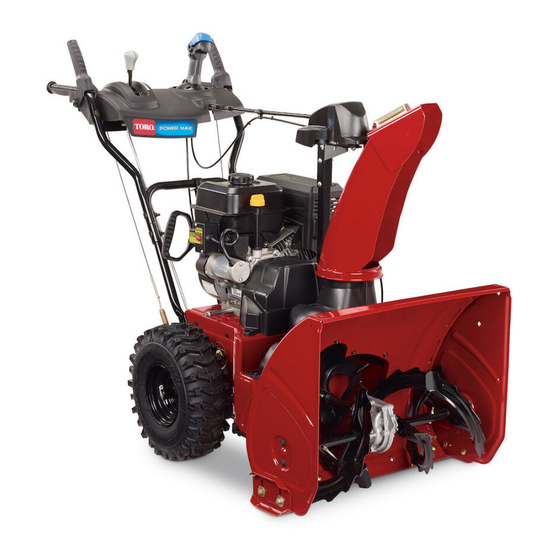

Related Manuals for Toro 37807


Summary of Contents for Toro 37807
- Page 1 Form No. 3468-829 Rev A Power Max ® 724 OE Snowthrower Model No. 37807—Serial No. 400000000 and Up *3468-829* Register at www.Toro.com. Original Instructions (EN)
- Page 2 Authorized Service overheat and damage the engine. Dealer or Toro Customer Service and have the model If you are unsure whether or not your machine has and serial numbers of your product ready.
-
Page 3: Safety Alert Symbol
Safety-Alert Symbol Safety The safety-alert symbol (Figure 2) shown in this General Safety manual and on the machine identifies important safety messages that you must follow to prevent accidents. This product is capable of amputating hands and feet and of throwing objects. Always follow all safety instructions to avoid serious personal injury. -
Page 4: Safety And Instructional Decals
Safety and Instructional Decals Safety decals and instructions are easily visible to the operator and are located near any area of potential danger. Replace any decal that is damaged or missing. Order Part No. 138-8487 120-9805 decal120-9805 120-9805 1. Insert the key. 2. - Page 5 decal137-6198 137-6198 1. Cutting/dismemberment 2. Warning—shut off the hazard of the fingers or engine before using the hand, impeller—do not tool to clear the chute. place your hand in the chute. Order Part No. 138-8487 decal121-1240 121-1240 1. Traction drive—squeeze the lever to engage; release the 4.
-
Page 6: Installing The Chute
Setup Installing the Chute No Parts Required Procedure g385316... -
Page 7: Installing The Upper Handle
Installing the Upper Handle No Parts Required Procedure g263892 Installing the Traction-Control Linkage No Parts Required Procedure g252391... -
Page 8: Installing The Chute-Control Rod
Installing the Chute-Control Rod No Parts Required Procedure g257848... -
Page 9: Installing The Snow-Cleanout Tool
Installing the Snow-Cleanout Tool No Parts Required Procedure g252394 Checking the Engine-Oil Level No Parts Required Procedure Note: Your machine comes with oil in the engine crankcase. Before starting the engine, check the oil level and add oil if necessary. Refer to Checking the Engine-Oil Level (page 20). -
Page 10: Checking The Tire Pressure
Checking the Tire Pressure No Parts Required Procedure g252396 Checking the Skids and Checking the Operation of Scraper the Traction Drive No Parts Required No Parts Required Procedure Procedure Refer to Checking and Adjusting the Skids and CAUTION Scraper (page 20). -
Page 11: Product Overview
Product Overview g001011 Figure 10 The machine should move rearward. If the machine does not move or moves forward, complete the following: Release the traction lever and shut off the engine. Disconnect the trunnion from the speed-selector lever. Turn the trunnion downward (clockwise) on the speed-control rod. -
Page 12: Before Operation Safety
Fill the fuel tank outdoors when the engine is cold. To ensure optimum performance and continued safety Replace the fuel cap securely and wipe up spills. certification of the machine, use only genuine Toro • Do not handle fuel when smoking or around an replacement parts and accessories. -
Page 13: Filling The Fuel Tank
Filling the Fuel Tank During Operation • For best results, use only clean, fresh (less than During Operation Safety 30 days old), unleaded gasoline with an octane rating of 87 or higher ((R+M)/2 rating method). • Oxygenated fuel with up to 10% ethanol or 15% General Safety MTBE by volume is acceptable. -
Page 14: Starting The Engine
when making any repairs, adjustments, or inspections. • Never operate the machine at high transport speeds on slippery surfaces. Starting the Engine Electric-Start Model Note: To use the electric starter (electric-start models only), connect a power cord to the plug-in first and then to a power outlet. -
Page 15: Shutting Off The Engine
Standard Model g254928 Figure 16 Shutting Off the Engine g252411 Figure 17 Operating the Traction To engage the traction drive, squeeze the left (traction) lever to the handgrip (Figure 18). Drive CAUTION If the traction drive is not properly adjusted, the machine may move in the direction opposite of what you intended, causing injury and/or property damage. -
Page 16: Operating The Speed Selector
Operating the Speed WARNING Selector If the auger and impeller continue to rotate when you release the The speed selector has 6 forward and 2 reverse auger/impeller lever, you could seriously gears. To change speeds, release the traction lever injure yourself or others. and shift the speed-selector lever to the desired Do not operate the machine. -
Page 17: Clearing A Clogged Discharge Chute
Clearing a Clogged • If the chute does not turn as far to the left as it does to the right, ensure that the cable is routed to Discharge Chute the inside of the handles. Refer to 2 Installing the Upper Handle (page •... -
Page 18: Operating Tips
Operating Tips After Operation DANGER After Operation Safety When the machine is in operation, the impeller and auger rotate and can injure or amputate General Safety hands or feet. • Never store the machine with fuel in the fuel • Before adjusting, cleaning, inspecting, tank inside a building where ignition sources are troubleshooting, or repairing the machine, present, such as hot water heaters, space heaters,... -
Page 19: Recommended Maintenance Schedule(S)
• Check all fasteners at frequent intervals for proper tightness to ensure that the machine is in safe working condition. • Do not change the governor settings on the engine. Purchase only genuine Toro replacement parts and accessories. -
Page 20: Checking And Adjusting The Skids And Scraper
Checking the Engine-Oil Level Service Interval: Before each use or daily—Check the engine-oil level and add oil if necessary. g257528 Checking and Adjusting the Important: The auger blades must be supported above the ground by the skids. Skids and Scraper Ensure that the scraper is 3 mm (1/8 inch) above Service Interval: Yearly—Check the skids and and parallel to a level surface. -
Page 21: Checking And Adjusting The Auger/Impeller Cable
Checking and Adjusting the If the machine does not drive in the forward or reverse speeds or it drives when you release the traction lever, Auger/Impeller Cable adjust the traction cable. If the left (traction) cable is not properly adjusted, do Service Interval: After the first 2 hours—Inspect the the following steps: auger/impeller cable and adjust it if... -
Page 22: Checking The Auger-Gearbox-Oil Level
Checking the Changing the Engine Oil Auger-Gearbox-Oil Level Service Interval: After the first 5 hours—Change the engine oil. Service Interval: Yearly—Check the auger-gearbox Yearly—Change the engine oil. oil and add oil if necessary. If possible, run the engine for a few minutes before Move the machine to a level surface. -
Page 23: Lubricating The Hex Shaft
g019018 Figure 33 g011606 1. Hex shaft 3. Rubber wheel Figure 32 2. Steel friction pulley Wait 3 minutes for the oil to settle in the engine. Important: Do not get oil on the rubber wheel or the steel friction pulley because the traction drive Wipe the dipstick clean with a clean cloth. -
Page 24: Replacing The Spark Plug
Wait until the engine is cool to replace the spark plug. Install the new spark plug, tighten it firmly, and Use a Toro spark plug or equivalent (Champion® attach the ignition wire to the spark plug. RN9YC or NGK BPR6ES). -
Page 25: Replacing The Headlight
Replacing the Headlight Model 37799 only Replace the headlight assembly (Toro part number 138-0670) when needed. Remove the headlight wire from the back of the headlight (A of Figure 38). Remove the bolt and nut holding the headlight assembly onto the headlight bracket and then remove the... -
Page 26: Removing The Machine From Storage
Tighten all loose screws, bolts, and locknuts. Repair or replace any damaged parts. Cover the machine and store it in a clean, dry place out of the reach of children. Removing the Machine from Storage Perform the annual maintenance procedures as given in the Recommended Maintenance Schedule;... -
Page 27: Troubleshooting
Troubleshooting Problem Possible Cause Corrective Action The electric starter does not turn 1. The power cord is disconnected at the 1. Connect the power cord to the outlet (electric-start models only). outlet or the machine. and/or the machine. 2. The power cord is worn, corroded, or 2. - Page 28 6. The auger/impeller drive belt is loose 6. Install and/or adjust the auger/impeller or is off the pulley. drive belt; refer to www.Toro.com for servicing information or take the machine to an Authorized Service Dealer. 7. The auger/impeller drive belt is worn 7.
- Page 29 Notes:...
- Page 30 Notes:...
- Page 31 While the exposure from Toro products may be negligible or well within the “no significant risk” range, out of an abundance of caution, Toro has elected to provide the Prop 65 warnings. Moreover, if Toro does not provide these warnings, it could be sued by the State of California or by private parties seeking to enforce Prop 65 and subject to substantial penalties.
Need help?
Do you have a question about the 37807 and is the answer not in the manual?
Questions and answers