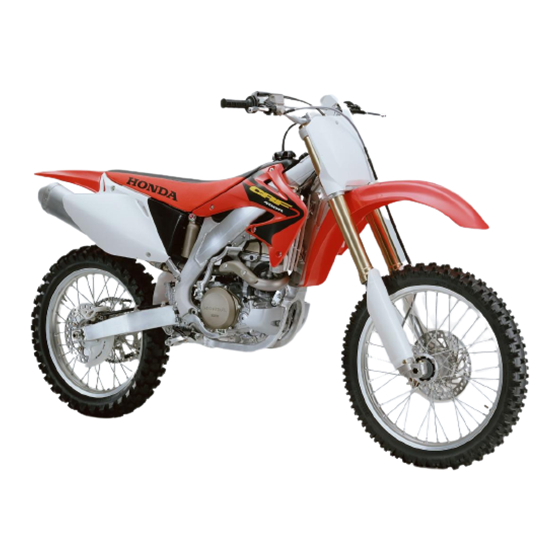
Honda CRF450R Owner's Manual
Hide thumbs
Also See for CRF450R:
- Owner's manual (177 pages) ,
- Owner's manual & competition handbook (5 pages) ,
- Owner's manual (172 pages)
Table of Contents
Advertisement
Quick Links
Honda CRF450R
OWNER'S MANUAL
2004
All information in this publication is based on the latest product information available at the time of
approval for printing. Honda Motor Co., Ltd. reserves the right to make changes at any time without
notice and without incurring any obligation.
No part of this publication may be reproduced without written permission.
© Honda Motor Co., Ltd. 2003
Advertisement
Table of Contents

Related Manuals for Honda CRF450R


Summary of Contents for Honda CRF450R
- Page 1 All information in this publication is based on the latest product information available at the time of approval for printing. Honda Motor Co., Ltd. reserves the right to make changes at any time without notice and without incurring any obligation.
- Page 2 TO THE NEW OWNER By selecting a Honda motocross CRF450R as your new The purpose of this Owner’s Manual is to help ensure Read this WARNING LABEL before you ride. motorcycle, you have placed yourself in a distinguished that you obtain the greatest possible satisfaction from family of motorcycle owners and riders.
-
Page 3: Table Of Contents
CONTENTS 14. STORAGE ............101 • Crankcase Breather ......... 27 1. OPERATING INSTRUCTIONS ......• To Prepare The Motorcycle For • Air Cleaner ..........27 Fuel ..............Storage ............ 101 • Clutch ............28 Basic Operation ..........• Valve ............30 •... -
Page 4: Operating Instructions
1.OPERATING INSTRUCTIONS BASIC OPERATION FUEL Starting The Engine Fuel tank capacity: 2.0 US gal (7.4 liter, 1.6 lmp gal) WARNING To open the fuel fill cap, pull the breather tube out of the Never run the engine in an enclosed area. The ex- •... -
Page 5: Stopping The Engine
Starting the engine after a stall during riding or after a Stopping The Engine Break-In Procedure fall: 1. Shift the transmission into neutral. Help assure your CRF’s future reliability and perfor- 2. Turn the fuel valve OFF. mance by paying extra attention to how you ride dur- 1. -
Page 6: Contotls
1.OPERATING INSTRUCTIONS CONTROLS HOT START LEVER CLUTCH LEVER FRONT BRAKE LEVER ENGINE STOP BUTTON THROTTLE GRIP FUEL FILL CAP CHOKE KNOB KICKSTARTER FUEL VALVE SHIFT LEVER REAR BRAKE PEDAL... -
Page 7: Control Adjustment
3. Loosen the lock nut and turn the integral cable ad- Clutch Lever Free Play CONTROL ADJUSTMENT juster to adjust the clutch lever free play 3/8 – 3/4 in 1. The normal clutch lever free play is 3/8 – 3/4 in Clutch Lever Position (10 –... -
Page 8: Hot Start
If proper adjustment still cannot be obtained or the adjustment, tighten the lock nut. clutch does not operate correctly, see pages 28 – 30, refer to the Honda Service Manual, or see your au- thorized Honda dealer for clutch disassembly and wear inspection. -
Page 9: Front Brake Lever
If the brake lever free play exceeds 0.8 in (20 mm), there 2. Tighten the lock nut at the desired pedal height. is probably air in the brake system and it must be bled. Refer to the Honda Service Manual or see your autho- rized Honda dealer for brake bleeding. CAUTION: •... -
Page 10: Adjustment For Personal Fit
3 mm (using optional handlebar lower hold- stiffer and softer, rear: stiffer and softer) are avail- rather than bending or breaking. Apply Honda able to tailor your CRF specifically for your weight, ers) or 6 mm (by rotating the standard holders 180 Thread Lock or an equivalent to the threads of these riding style and course conditions. -
Page 11: Specifications
2. SPECIFICATIONS Item English Metric Item English Metric Item English Metric Dimension Engine Drive train Overall length 86.4 in Type Liquid cooled, 4-stroke Clutch type Wet, multi-plate type 2,194 mm Single 6˚ inclined from Overall width 32.6 in Transmission 5-speed, constant mesh 827 mm Cylinder arrangement vertical... -
Page 12: Optional Parts
Driven sprocket < >: Drive chain links Shock spring These parts and tools may be ordered from your au- Standard 48 Teeth, Aluminum. Standard 308.0 lbf/in (5.50kgf/mm) thorized Honda dealer. <114> No mark CARBURETOR Remarks (factory products) Optional 47 Teeth, Aluminum Main jet #155 –... -
Page 13: Service And Maintenance
4. SERVICE AND MAINTENANCE PRE-RIDE INSPECTION CHECK LIST MAINTENANCE SCHEDULE Pre-ride Inspection Perform the Pre-ride Inspection at each scheduled maintenance period. l: Inspect and Clean, Adjust, Lubricate or Replace if necessary. C: Clean. R: Replace. L: Lubricate. WARNING • If the Pre-ride and Pre-race inspection are not Every 3 Every 6 Every 9... -
Page 14: General Service Information
Check spoke tension and rim lock nut security. them to the specified torque using a crisscross pattern. • Use genuine Honda parts or their equivalent when servicing your CRF. • Clean parts in non-flammable cleaning solvent when disassembling. Lubricate any sliding surface, O- rings. -
Page 15: After Race Maintenance
AFTER RACE MAINTENANCE A variety of reasonably priced cleaning brushes are After Cleaning Lubrication available from variety, drug, food and hardware stores Although you can basically follow the suggestions It is important to the long term performance of your that are extremely useful in removing dirt from the given in the Maintenance section under General Main- CRF to properly maintain your racebike at all times. -
Page 16: General Maintenance
(page 27) Use the Honda genuine air cleaner or an equivalent air cleaner specified for your model. Using the wrong Honda air cleaner or a non-Honda •... - Page 17 Inspect the cable carefully for shorts or corrosion. Additional corrosion protec- kinks or other damage that may restrict throttle con- tion is offered by using Honda Dielectric Grease on trol in anyway. Move the handlebar from lock to lock all electrical connections.
- Page 18 (containing more suspension. Refer to the Honda Service Manual. Use than 40% molybdenum disulfide additive). only Pro Honda HP Fork Oil 5W or equivalent which contains special additives to assure maximum per- formance of your CRF's front suspension.
-
Page 19: Maintenance Preparations
MAINTENANCE PREPARATIONS Seat Installation FUEL TANK 1. Slide the seat front prong onto the seat bracket and SEAT Fuel Tank Removal the seat rear prongs onto the tabs by pushing down 1. Turn the fuel valve OFF. and forward on the seat in each of these areas. Seat Removal 2. - Page 20 4. SERVICE AND MAINTENANCE Fuel Tank Installation 8. Disconnect the fuel line from the fuel valve. 6. Put the breather tube in the steering stem nut. The fuel line leading to the carburetor must be dis- 1. Install the fuel tank on the frame. connected, not the fuel line leading to the fuel tank.
-
Page 21: Subframe
5. Disconnect the crankcase breather tube. SUBFRAME Subframe Installation 6. Loosen the screw on the air cleaner connecting tube 1. Loosely attach the upper and lower ends of the Subframe Removal clamp. subframe to the mainframe while connecting the 1. Remove the seat (page 17). air cleaner connecting tube to the carburetor. - Page 22 4. SERVICE AND MAINTENANCE 6. Install the muffler. 10. Install the side covers, side cover bolts and collars. 2. Tighten the screw on the air cleaner connecting tube 7. Install the muffler clamp by aligning the tab of the clamp. 11.
-
Page 23: Maintenance Procedures
Replacing Engine Oil and Filter MAINTENANCE PROCEDURES 8. Remove the left engine guard bolt and left engine guard. 1. Run the engine at idling for a few minutes, then shut ENGINE OIL it off. Inspecting and Adding Engine Oil 2. Support the CRF in an upright position on a level 1. - Page 24 0.70 US qt (0.66 liter, 0.58 Imp qt) SIDE” mark on the filter body, near the seal. at oil change Use a new genuine Honda oil filter or a filter of equal 17. Install the engine oil filler cap. quality specified for your model.
-
Page 25: Transmission Oil
Recommended Transmission Oil 1. Run the engine for three minutes, then shut if off. Use Pro Honda HP Trans Oil, Pro Honda GN4 or HP4 Inspecting and Adding Transmission Oil 2. Support the CRF in an upright position on a level (without molybdenum additives) 4-stroke oil, or an 1. -
Page 26: Coolant
Coolant Recommendation NOTE : with in the indicated range. Use Pro Honda HP coolant or an equivalent high qual- • Inspect the coolant level before each outing. A ity ethylene glycol based anti-freeze containing corro- coolant loss of 0.7 –... -
Page 27: Spark Plug
SPARK PLUG 1. Remove the fuel tank (page 17). 2. Disconnect the spark plug cap. Standard: 3. Remove the spark plug. (NGK) IFR8H11 (DENSO) VK24PRZ11 For extended high speed riding: (NGK) IFR9H11 (DENSO) VK27PRZ11 If replacing with any other brand of spark plug, be cer- tain to select the correct reach and heat range. -
Page 28: Ignition
If you want to check the igni- Coast to a stop, then remove and inspect the spark the same number of turns. tion timing, refer to the Honda Service Manual. plug. The porcelain insulator around the center elec- trode should appear tan or medium gray. -
Page 29: Crankcase Breather
8. Allow the air cleaner to dry thoroughly. After dry- ing, soak the air cleaner in clean Pro Honda Foam Filter Oil or an equivalent air cleaner oil. Apply air cleaner oil to the entire surface, inner and outer, and rub it with both hands to saturate the air cleaner with oil. -
Page 30: Clutch
4. SERVICE AND MAINTENANCE 11. Install the assembly into the air cleaner housing CLUTCH Remove the six clutch spring bolts and clutch springs. keeping the two access top tabs up. NOTE: Operation 12. Carefully position the sealing flange of the element •... - Page 31 Clutch Spring Clutch Disc/Plate Installation Install the clutch pressure plate. The clutch springs have sky blue paint. Coat the clutch plates with transmission oil. Install the six clutch springs and bolts. Measure each clutch spring’s free length. Install the six clutch discs which has yellow paint on Tighten the bolts in a crisscross pattern in 2 or 3 steps.
-
Page 32: Valve
4. SERVICE AND MAINTENANCE Connect the brake pedal return spring if it was re- VALVE Positioning At Top Dead Center On The Compression moved. Stroke. Cylinder Head Cover Removal Remove the crankshaft hole cap. Lubricate the rear brake pedal pivot and pivot bolt and NOTE: tighten the pivot bolt. - Page 33 Rotate the crankshaft by turning the primary drive gear Valve Clearance And Decompressor Arm Clearance In- If intake valve clearance and exhaust valve clearance lock bolt (crankshaft) clockwise until aligning the “T” spection need adjustment, see Camshaft Holder Assembly Re- mark on the primary drive gear with the index mark on Measure the intake valve clearance by inserting a feeler moval (page 32) and select the collect shim in each...
- Page 34 4. SERVICE AND MAINTENANCE Cam Shaft Holder Assembly Removal Remove the cam chain tensioner lifter cover bolt and Make a tensioner shaft stopper tool out of a thin piece Record the intake valve clearance, exhaust valve clear- sealing washer. of steel (0.8 mm thick) using the diagram. ance and decompressor arm clearance.
- Page 35 Remove the cam sprocket bolt. Remove the camshaft holder assembly bolts, camshaft Rotate the primary drive gear lock bolt (crankshaft) holder assembly, intake valve lifters and shims. clockwise one turn and remove the other sprocket bolt and cam sprocket. Then attach a piece of wire to the As you remove the camshaft holder assembly, the in- cam chain to prevent it from falling into the crankcase.
- Page 36 4. SERVICE AND MAINTENANCE Shim Selection Calculate the new shim thickness using the equation Camshaft Holder Assembly Installation Clean the valve shim contact area in the valve lifter with below. Install the newly selected shims on the valve retainers. compressed air. CAUTION: A = (B –...
- Page 37 Install the cam shaft holder assembly onto the cylinder Insert the feeler gauge between the intake valve lifter Place the cam sprocket and align the timing mark on head with the intake cam lobes facing up as illustrated and cam lobe. the cam sprocket with the mark on the camshaft below.
- Page 38 4. SERVICE AND MAINTENANCE Clean and apply a locking agent to the cam sprocket Remove the stopper tool from the cam chain tensioner Tighten the cam sprocket bolt, then tighten the other bolt threads (coating width: 0.26 in (6.5 mm) from tip). lifter.
- Page 39 Measure the intake valve clearance and exhaust valve Measure the decompressor arm clearance by inserting Decompressor Arm Clearance Adjustment clearance. a feeler gauge between the decompressor arm adjust- Make sure that the piston is at top dead center on the ing screw and right side rocker arm.
- Page 40 4. SERVICE AND MAINTENANCE Loosen the lock nut and adjusting screw. Spark Plug Installation Cylinder Head Cover Installation Insert the feeler gauge (right exhaust valve clearance Install the spark plug by hand until finger tight, then Remove the spark plug hole packing from the cylinder 0.014 in (0.35 mm);...
-
Page 41: Piston/Piston Rings/Piston Pin
Install the cylinder head cover, cylinder head cover B Disconnect the spark plug cap and remove the ignition PISTON/PISTON RINGS/PISTON PIN bolts and cylinder head cover A bolt. coil nut, ignition coil bots and ignition coil. Cylinder Head Removal TORQUE: 7 lbf ft (10 N m, 1.0 kgf m) NOTE: •... - Page 42 4. SERVICE AND MAINTENANCE Position the piston at top dead center on the compres- Remove the cylinder head bolts. Remove the engine hanger nut, engine hanger A bolt, sion stroke (page 30). Loosen the cylinder bolt. right collar, left collar and fuel hose guide. Remove the cam shaft holder assembly (page 32).
- Page 43 Remove the dowel pins, cylinder head gasket and cam Piston Removal Cylinder Removal chain guide. Place clean shop towels in the crankcase to keep the Remove the cylinder bolt and cylinder. piston pin clips, or other parts, from falling into the CAUTION: crankcase.
- Page 44 Apply engine oil to the piston rings and install the pis- We recommended you consult the Service Manual or ton rings. your authorized Honda dealer for correct Service Limit measurements. CAUTION: Do not damage the piston ring by spreading the •...
- Page 45 Piston Installation Cylinder Installation Clean off any gasket material from the gasket surface Place clean shop towels in the crankcase to keep the of the crankcase, being careful not to let any material piston pin clips from falling into the crankcase. fall into the crankcase.
-
Page 46: Cylinder Head Installation
4. SERVICE AND MAINTENANCE Apply fresh engine oil to the cylinder wall, piston outer Install the cam chain guide and fit the cam chain guide Cylinder Head Installation surface and piston rings. tabs in the cylinder cut-outs. Install the dowel pins and new cylinder head gasket. Route the cam chain though the cylinder. - Page 47 Route the cam chain through the cylinder head. Install the cylinder bolt and cylinder head bolts to the Install the cylinder head. specified torque. CAUTION: TORQUE: 7 lbf ft (10 N m, 1.0 kgf m) • Do not damage mating surfaces when installing the cylinder head.
- Page 48 4. SERVICE AND MAINTENANCE Connect the radiator hose to the cylinder head and Install the crankshaft hole cap (page 38). Install a new exhaust pipe gasket, exhaust pipe and tighten the radiator hose clamp securely. Install the cylinder head cover (page 38). exhaust pipe joint nuts and tighten to the specified Install the ignition coil, ground terminal, ignition coil torque.
-
Page 49: Handlebar And Steering Head Bearings
If any roughness or play is felt, refer to the Honda Service Manual for replacement or ad- justment procedures. (1) RADIATOR CAP Check for the following: –... -
Page 50: Fuel Line
4. SERVICE AND MAINTENANCE FUEL LINE Fuel Filter 5. Reassemble the fuel filter in the reverse order of re- moval. Make sure the O-ring is in place. 1. Check the fuel valve and fuel filter for contamina- The fuel filter is mounted on the bottom of the fuel tank. Install the fuel filter in the fuel tank. -
Page 51: Front And Rear Wheels And Tires
0.06 in (1.5 mm) or flat with the outer tube. (1) RIM LOCK (2) LOCK NUT Axles And Wheel Bearings (See the Honda Service Manual for inspection): (1) WEAR RING (2) OUTER TUBE 1. Check the axle for runout. -
Page 52: Rear Suspension
Do not attempt to disassemble, disconnect or replacement. service the damper unit; an explosion, causing se- • Use Pro Honda HP Fork Oil 5W or an equivalent rious injury may result. which contains special additives to assure maximum •... -
Page 53: Brakes
Rein- is probably air in the brake system and it must be bled. stall the diaphragm and reservoir cap. Refer to the Honda Service Manual or see your autho- Tighten the screws. rized Honda motorcycle dealer for brake bleeding. -
Page 54: Drive Chain
4. SERVICE AND MAINTENANCE Front Brake Pads Rear Brake Pads DRIVE CHAIN Inspect the pads visually through the front wheel to Inspect the pads visually from the rear side of the cali- Regular cleaning, Iubrication, and proper adjustment determine the pad wear. If either pad is worn anywhere per to determine the pad wear. - Page 55 Adjustment Removal, Cleaning and Inspection 1. Loosen the rear axle nut. For maximum service life, the drive chain should be 2. Loosen the lock nuts and turn the adjusting bolt cleaned, lubricated, and adjusted before each outing. counterclockwise to decrease slack or clockwise to 1.
-
Page 56: Drive Chain Sliders
Lubrication Commercially prepared drive chain lubricants may be purchased at most motorcycle shops and should be used in preference to motor oil. Pro Honda Chain (1) CHAIN SLIDER Lube or an equivalent, or SAE 80 or 90 gear oil is recommended. -
Page 57: Driven Sprocket
DRIVEN SPROCKET EXHAUST PIPE/MUFFLER 2. Loosen the muffler clamp bolt. 3. Remove the muffler A bolt, muffler B bolt/washer Check the driven sprocket nut torque values after each Inspection and muffler. race. 1. Check the flange bolts for tightness. 2. Check the exhaust pipe and muffler for cracks or TORQUE: 24 lbf ft (32 N m, 3.3 kgf m) deformation. - Page 58 4. SERVICE AND MAINTENANCE Muffler Installation Exhaust Pipe Removal 5. Tighten the muffler B bolt and muffler A bolt. 1. Remove the muffler (page 55). 1. Remove the gasket. 2. Remove the exhaust pipe joint nuts, exhaust pipe TORQUE: 16 lbf ft (22 N m, 2.2 kgf m) 2.
-
Page 59: Control Cables
Exhaust Pipe Installation CONTROL CABLES 1. Install a new exhaust pipe gasket, exhaust pipe and Lubrication exhaust pipe joint nuts and tighten to the specified Periodically, disconnect the throttle, clutch and hot start torque. cables at their upper ends. Thoroughly lubricate the cable pivot points and the inside of clutch cable end TORQUE: 15 lbf ft (21 N m, 2.1 kgf m) adjuster with a commercially available cable lubricant. -
Page 60: Nuts, Bolts, Fasterers
4. SERVICE AND MAINTENANCE NUTS, BOLTS, FASTENERS Torque Remarks Item Check and tighten nuts, bolts, and fasteners before every outing. lbf•ft N•m kgf•m ENGINE Engine Cylinder head cover Clutch cover Water pump cover Transmission oil check bolt Crankshaft hole cap Oil filter cover Cylinder bolt Cylinder head bolt... - Page 61 NOTE 2, 4 (Frame side) Shock spring lock nut Kickstarter arm bolt NOTES: 1. Apply Honda Thread Lock or an equivalent to the threads. 2. Apply oil to the threads and flange surface. 3. Stake. 4. U-nut. 5. UBS nut.
- Page 62 Rear brake reservoir cap bolts 0.15 0.12 Fork air plugs NOTES: 1. Apply Honda Thread Lock or an equivalent to the threads. 2. Apply oil to the threads and flange surface. 3. Stake. 4. U-nut. 5. UBS nut. 6. SH bolt.
-
Page 63: Carburetor Adjustment
5. CARBURETOR ADJUSTMENT CARBURETOR • Hot Start Circuit • Accelerator Pump Circuit A lean mixture must be delivered to the cylinder when The accelerator pump circuit operates when the throttle The carburetor used on your CRF will seldom experi- hot engine is being started. When the hot start lever is is opened. - Page 64 5. CARBURETOR ADJUSTMENT • Main Circuit Disassembly/Assembly • Slow Circuit 1. Turn the fuel valve OFF. Fuel is metered by the main jet, jet needle and needle Fuel is metered by the slow jet and mixed with air from 2. Drain the remaining fuel in the float bowl by remov- jet.
- Page 65 4. Disconnect the fuel line. 10. Remove the hot start cable holder. 12. Remove the throttle drum cover bolt and throttle 5. Remove the fuel tank (page 17). drum cover. 6. Remove the sub frame (page 19). 7. Loosen the intake band screw. (1) HOT START CABLE HOLDER (1) THROTTLE DRUM COVER BOLT 11.
- Page 66 5. CARBURETOR ADJUSTMENT 14. Remove the carburetor top bolts and carburetor top. 16. Remove the link arm set screw. When installing the floating valve onto the throttle When installing the link arm set screw, apply a lock- valve make sure the floating valve’s flat side faces ing agent to the link arm set screw threads.
- Page 67 18. Remove the accelerator pump cover screws and ac- 20. Remove the holder screw, throttle stop screw holder, 22. Measure the float level with the float tab just con- celerator pump cover. float bowl screws, tube guides and float bowl. tacting the float valve and the carburetor intake fac- ing up.
- Page 68 5. CARBURETOR ADJUSTMENT To assemble, reverse the disassembly procedures. Pre-adjustment Checks To install the carburetor, reverse the removal proce- Before adjusting carburetor settings, check the follow- dures. ing: NOTE: 1. air cleaner condition (page 27) • After installing the carburetor, adjust the throttle 2.
- Page 69 Adjustment Procedure 7. If you’ve determined that the main and slow jets 11. Change the main jet and slow jet as required. must be changed, you must rotate the carburetor 1. Turn the pilot screw in until it is lightly seated and and remove the float bowl plug.
- Page 70 5. CARBURETOR ADJUSTMENT 13. Rotate the carburetor and align the lug on the car- 18. Remove the carburetor top bolts and carburetor top. 21. Reinstall the jet needle, jet needle holder carbure- buretor with the slot on the intake tube. tor top and carburetor top bolts.
- Page 71 NOTE: justment is 1/2 to 2 1/2 turns out from the lightly • Honda carburetor jet sizes are numbered in incre- seated position. ments of 2 or 3. When changing the main jet size, If you exceed 2 1/2 turns out, the next larger slow increase or decrease it gradually until the desired jet is needed.
-
Page 72: Tuning For Special Conditions
5. CARBURETOR ADJUSTMENT TUNING FOR SPECIAL CONDITIONS All jetting is based on * Standard jetting Once you’ve adjusted the carburetor for temperature and altitude, it shouldn’t * Unmodified Engine need major readjustment unless race conditions change drastically. However, there are some unique atmospheric conditions or race day situations that may require additional adjustments. -
Page 73: Suspention Adjustment
6. SUSPENSION ADJUSTMENT RACE SAG The Race Sag dimension is the difference between the Unloaded and the Loaded measurements. Standard Race sag: 3.9 in (100 mm) Standard Race Sag: 3.9 in (100 mm) There are a series of adjustments that should be per- UNLOADED MEASUREMENT formed on a factory-new CRF;... -
Page 74: Rear Suspension
1/16 in (1.5 mm). Both lighter and heavier than standard springs are avail- able for the shock and fork from your authorized Honda dealer. The need for a stiffer or softer than standard shock spring may require the installation of optional rate fork springs as well in order to maintain proper front/rear suspension balance. - Page 75 Rebound Damping Compression Damping The rebound damping adjuster has 17 positions or The compression damping may be adjusted in two more. Turning the adjuster screw one full turn clock- stages with separate adjusters. wise advances the adjuster four positions. To adjust the rebound damping to the standard setting, proceed as The high speed damping adjuster is effective when follows:...
-
Page 76: Front Suspension
6. SUSPENSION ADJUSTMENT FRONT SUSPENSION NOTE: Fork Springs • The inverted fork on your CRF features sealed damper The fork should always be adjusted for the rider's weight The fork springs in CRF’s are about right for riders cartridges with dual (separate air and oil) chambers and track conditions by using one or more of the fol- weighing between 150 and 160 Ibs (less riding gear). - Page 77 See the The adjuster is set in the standard position when the positions or the adjuster may be damaged. Service Manual or your authorized Honda dealer for Be sure that the rebound and compression adjust- adjuster is turned counterclockwise 7 clicks.
- Page 78 6. SUSPENSION ADJUSTMENT Remove the handlebar pad. Loosen the upper pinch bolts. Remove the disc cover by removing the two bolts. Remove the handlebar holder nuts, washers, mount- Loosen the fork dampers, but do not remove them yet. ing rubbers and handlebar. CAUTION: CAUTION: •...
- Page 79 Remove the fork protector and brake caliper. Clean the fork assembly, especially the sliding surface Record the rebound damping adjuster position and turn of the slider and dust seal. the adjuster counterclockwise until it stops. CAUTION: CAUTION: Do not support the brake caliper by the brake hose. •...
- Page 80 6. SUSPENSION ADJUSTMENT Drain the fork oil by turning the outer tube upside down. Pour the fork oil from the outer tube. Amount of fork oil left in the fork (About 12 cc of fork oil will be left in the outer tube Pour the fork oil from the oil hole of the fork damper.
- Page 81 Pour the recommended fork oil into the outer tube. Fork Oill Capacity: Optional Stiffer (0.49 kgf/mm) Fork Spring Standard (0.47 kgf/mm) Fork Spring RECOMMENDED OIL: Pro Honda HP Fork Oil 5 W or equivalent. Standard oil 13.9 US oz Standard oil 14.1 US oz...
- Page 82 6. SUSPENSION ADJUSTMENT Check that the O-ring on the fork damper is in good Temporarily thread the fork damper into the outer tube. Tighten the fork lower pinch bolts. condition. Apply the recommended fork oil to the O- Insert both fork legs into the fork clamps. Align the ring.
- Page 83 Clean the threads of the fork protector bolts and axle Clean the surfaces where the axle and axle clamps con- Align the brake caliper and hose with the left fork leg, holder thoroughly. tact each other. making sure that the brake hose is not twisted. Apply locking agent to the bolt threads.
- Page 84 6. SUSPENSION ADJUSTMENT Install and tighten the number plate bolt. Install the handlebar, mounting rubbers, washers and handlebar holder nuts and tighten the handlebar holder Install the handlebar pad. nuts. TORQUE: 33 Ibf ft (44 N m, 4.5 kgf m) (1) FRONT AXLE (2) AXLE PINCH BOLTS (3) AXLE NUT...
- Page 85 Fork Disassembly Pour the fork oil from the outer tube. Push out the fork center bolt from the axle holder of the Pour the fork oil from the oil hole of the fork damper. slider by pushing the fork damper. Remove the fork as described in Fork Oil Change (pages 75 –...
- Page 86 6. SUSPENSION ADJUSTMENT Remove the push rod from the fork damper. Damper Oil Change Remove the fork cap from the fork damper. NOTE : CAUTION: Remove the special tool or mechanic's stopper tool • Be careful not to damage the fork cap bushing. between the axle holder and lock nut while applying •...
- Page 87 OIL LEVEL: 1.65 – 1.85 in (42 – 47 mm) TORQUE: 22 Ibf ft (29 N m, 3.0 kgf m) RECOMMENDED OIL: Pro Honda HP Fork Oil 5 W or equivalent Recommended Amount: 6.6 US oz (195 cc, 6.9 Imp oz) 1.65 –...
- Page 88 6. SUSPENSION ADJUSTMENT Screw in the lock nut to the fork damper piston rod fully. Drain the extra oil from the fork damper spring cham- If you can not use compressed air, remove the pres- ber oil hole. sure release screw on the fork cap. Hold the fork damper up side down for 10 minutes and drain the oil from the fork damper spring chamber.
- Page 89 Fork Assembly Tighten the lock nut fully and measure the thread length Amount of fork oil left in the fork Drain the fork oil from the outer tube/slider by placing as shown. (without damper and spring) unit: cc it upside down. minute (About 7 cc of fork oil will be left in the outer tube/slider STANDARD: 0.43 –...
- Page 90 6. SUSPENSION ADJUSTMENT Set the lower end (axle holder) of the slider in a vise Measure the length of the lock nut and center bolt clear- Apply fork oil to the center bolt O-ring. with a piece of wood or soft jaws to avoid to damage. ance.
- Page 91 Pour the racommended fork oil into the fork. Fork Oill Capacity: Optional Stiffer (0.49 kgf/mm) Fork Spring Standard (0.47 kgf/mm) Fork Spring RECOMMENDED OIL: Pro Honda HP Fork Oil 5 W or equivalent. Standard oil 13.7 US oz Standard oil 13.9 US oz...
-
Page 92: Suspension Adjustments Relating To Specific Track Conditions
6. SUSPENSION ADJUSTMENT Air Pressure Adjustment SUSPENSION ADJUSTMENTS RELATlNG TO SPECIFIC The air pressure should be adjusted according to the TRACK CONDITIONS altitude and outside temperature. On soft ground, sand tracks and especially muddy tracks, you want more compression damping force front 1. -
Page 93: Suspension Adjustment Guidelines
SUSPENSION ADJUSTMENT GUIDELINES Follow the procedures described below to accurately adjust your CRF using the methods described on pages 72 – 89. Remember to make all adjustments in one-clik increments. Test ride after each adjustment. Fork Adjustment Adjustments for Type of Track Hard-surfaced track Begin with the standard setting. - Page 94 6. SUSPENSION ADJUSTMENT Symptom Action Stiff Initial travel too stiff: – Test softer compression damping adjustments in one-click increments. suspension • Stiff on small bumps while riding at full throttle in a straight line. – Reduce the rebound damping adjustments in one-click increments. •...
- Page 95 Rear Suspension Adjustment Adjustments for Type of Track Hard-Surfaced track Begin with the standard setting. If the suspension is too stiff/soft, adjust according to the chart below. Sand track Lower the rear end (to impove front wheel stability) by increasing Race Sag (reduce spring preload). Example: –...
-
Page 96: Chassis Adjustments For Track Conditions
7. CHASSIS ADJUSTMENTS FOR TRACK CONDITIONS 8. GEARING SELECTION Rear End Explanation Of Effects On Power Delivery & Traction NOTE : If you have a problem with rear wheel traction, you can Rather than counting on frequently unreliable, aftermar- • Never position the top surface of the triple clamp run a little bit more preload on the spring. -
Page 97: Tire Selection
Use a stopwatch for consistency. first or somewhere in the pack. The tires your CRF tools, and an authorized Honda Service Manual, "Seat-of-the-pants" feelings can't be trusted since elimi- comes equipped with are a perfect "happy medium"... -
Page 98: Maintenance, Tuning & Racing Logbook
10. MAINTENANCE, TUNING & RACING LOGBOOK Any serious racing effort relies heavily on knowledge Maintenance Records Racing Records gained and compiled from previous racing events. In- Regular Maintenance items you'll want to record in your Information worth recording for this section of your formation such as what gearing was used, weather/ al- Iogbook should include: Iogbook may include:... - Page 99 MAINTENANCE, TUNING & RACING LOGBOOK Running Location/ Date Time Event Comments (Jetting, Suspension Settings, Gearing, Chassis Adjustments, Maintenance Performed, etc.) (Make several photocopies of this page for future use)
-
Page 100: Spare Parts & Equipment
(Engine Oil) clamps, silicone sealer, contact cleaner and greases Wrenches – Open end and Box Pro Honda HP Trans Oil or Pro Honda GN4 or HP4 (with- consider the following: Wrenches – Hex (AIlen) out molybdenum additives only) 4-stroke Oil (Transmis- Wrench –... -
Page 101: Troubleshooting
1. Disconnect fuel FUEL FLOW (1) Lack of fuel in tank thesis. The items that require use of the Honda Ser- RESTRICTED (P-2) line at carburetor vice Manual are followed by an asterisk. -
Page 102: Cleaning
13. CLEANING Clean your CRF regularly to protect the surface finishes Aluminum Frame Maintenance Exhaust Pipe Maintenance and inspect for damage, wear, and oil leakage. Aluminum corrodes when it comes in contact with dust, The exhaust pipe is titanium and stainless steel, but When washing your CRF always use water or water and mud and road salt. -
Page 103: Storage
8. Inflate the tires to their recommended pressures. 9. Place your CRF on the optional Honda workstand or equivalent to raise both tires off the ground. 10. Stuff a rag into the silencer outlet. Then tie a plastic bag over the end of the silencer to prevent moisture from entering. -
Page 104: Wiring Diagram
15. WIRING DIAGRAM... -
Page 105: Index
16. INDEX Additional individualized adjustments ..............8 Hot start ........................6 Adjustment for personal fit ..................8 Ignition ........................26 After cleaning lubrication ..................13 Maintenance preparations ................... 17 After race lubrication ................... 13 Maintenance procedures ..................21 After race maintenance ..................13 Maintenance schedule .................. - Page 106 MEMO...
-
Page 107: Authorized Manuals
For purchases outside U.S.A., please write to the address shown below for a quotation. Also available, but not necessary to service your model is the Honda Common Service Manual (Publication No. 61CM001), which explains theory of operation and... - Page 108 MEMO...
Need help?
Do you have a question about the CRF450R and is the answer not in the manual?
Questions and answers