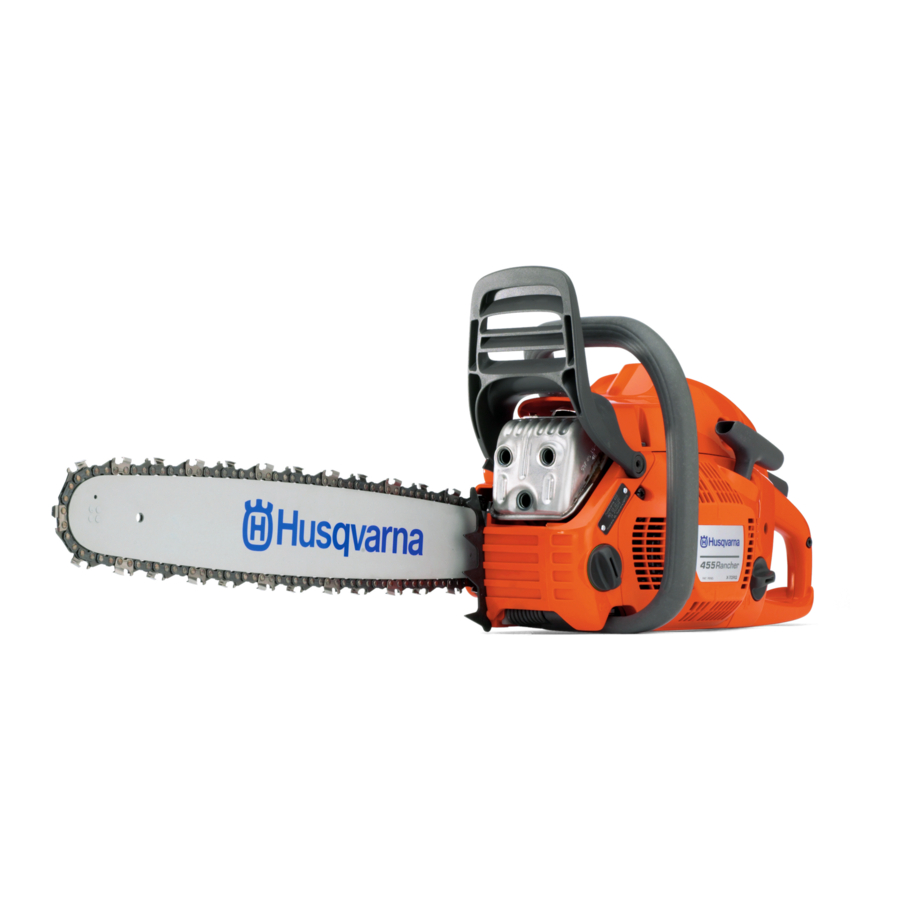
Husqvarna Rancher 455 Operator's Manual

Husqvarna Rancher 455 Operator's Manual

Husqvarna electric lawn mower operator's manual
Hide thumbs Also See for Rancher 455:
Table of Contents

Advertisement

Oper ator's manual (EPA II)
455 Rancher 460
Please r ead the operator's manual carefully and make sure you
E E E E n n n n g g g g l l l l i i i i s s s s h h h h
understand the instructions before using the machine.

Advertisement

Table of Contents
loading

Frequently Asked Questions (36)

  • Why is my Husqvarna Rancher 455 chainsaw not starting when I pull the cord?

    Your Husqvarna Rancher 455 chainsaw may not start when you pull the cord due to several reasons, along with their solutions:

    • Dirty Air Filter: A dirty air filter can lead to starting problems. Regularly clean the air filter.
    • Spark Plug Issues: If the machine is difficult to start, check the spark plug. If it's dirty, clean it and ensure the electrode gap is 0.5 mm (0.020"). The spark plug should be replaced after about a month in operation or earlier if necessary.
    • Incorrect Low Speed Jet (L-jet) Adjustment: If the L-jet is set too lean, it may cause starting difficulties.
    • Decompression Valve Not Pressed: For cold starts, you should always press the decompression valve to reduce cylinder pressure and make starting easier.
    • Contaminated Fuel Tank: Contamination in the tanks can cause malfunctions. The fuel filter must be replaced at least once a year, and the tank should be cleaned.
    • Damaged Fuel Hose: Check the fuel hose for cracks or other damage and change it if necessary.
    • Improper Starting Procedure: Ensure you follow the correct starting procedure for either a cold engine or a warm engine, including engaging the chain brake and ensuring the chain is not touching anything.
    Was this helpful?
  • How do I start a Husqvarna Rancher 455 chainsaw?

    To start your Husqvarna Rancher 455 chainsaw, ensure the chain brake is engaged, the bar, chain, and all covers are fitted correctly, and you have a secure footing with no objects near the chain. Keep people and animals away from the working area.

    For a cold engine:

    1. Activate the chain brake by pushing the front hand guard forwards.
    2. Set the choke control to the choke position (A). This will automatically set the stop switch to the start position.
    3. Press the air purge bulb (B) repeatedly until fuel begins to fill it; it doesn't need to be completely filled.
    4. Press the decompression valve (C) to reduce cylinder pressure and make starting easier. This valve will automatically return to its original setting once the machine starts.
    5. Grip the front handle with your left hand. Hold the chainsaw on the ground by placing your right foot through the rear handle. Pull the starter handle with your right hand slowly until you feel resistance, then pull firmly and rapidly. Do not pull the cord all the way out or let go of the handle when the cord is fully extended.
    6. As soon as the engine fires, push in the choke control and make repeated starting attempts.
    7. Immediately press and release the throttle when the engine starts. This will disengage the throttle latch.

    For a warm engine:

    1. Use the same procedure as for a cold engine, but without setting the choke control in the choke position. The correct choke/start throttle setting is obtained by moving the choke control to the choke position and then pushing it in again.

    After starting, as the chain brake is still activated, the engine must return to idling speed as soon as possible by disengaging the throttle latch to avoid unnecessary wear on the clutch assembly.


    For more information, see page 19 of the manual.
    Was this helpful?
  • Why does my Husqvarna Rancher 455 chainsaw keep stalling?

    Your Husqvarna Rancher 455 chainsaw may stall due to several reasons, along with their solutions:

    • Dirty Air Filter: A dirty air filter can lead to starting problems and loss of engine power. Regularly clean the air filter.
    • Incorrect Carburetor Adjustment:
      • Low Speed Jet (L-jet): If the engine accelerates poorly or idles unevenly, turn the low speed jet L anticlockwise until good acceleration and idling are achieved. If the L-jet is set too lean, it may cause starting difficulties and poor acceleration.
      • Idle Speed (T-screw): If the chain rotates while idling, the T-screw must be turned anti-clockwise until the chain stops. A correctly adjusted idle speed setting occurs when the engine runs smoothly in every position.
    • Spark Plug Issues: If the machine runs poorly at idle speed, check the spark plug. If it's dirty, clean it and ensure the electrode gap is 0.5 mm (0.020"). The spark plug should be replaced after about a month in operation or earlier if necessary.
    • Cold Weather Conditions: In cold and snowy conditions, stalling can occur due to too low engine temperature or icing of the air filter and carburetor. To address this, you may need to partly mask the air inlet on the starter to increase the working temperature of the engine.
    Was this helpful?
  • How do I tighten the chain on my Husqvarna Rancher 455 chainsaw?

    To tighten the chain on your Husqvarna Rancher 455 chainsaw, follow these steps:

    1. Loosen the bar nuts that hold the clutch cover/chain brake using the combination spanner. Then, tighten the bar nuts by hand as tight as you can.
    2. Raise the tip of the bar and stretch the chain by tightening the chain tensioning screw using the combination spanner. Tighten the chain until it does not sag from the underside of the bar.
    3. Use the combination spanner to tighten the bar nuts while lifting the tip of the bar at the same time.
    4. Check that you can pull the chain round freely by hand and that it does not sag from the underside of the bar. The chain is correctly tensioned when it does not sag from the underside of the bar, but can still be turned easily by hand.

    For more information, see pages 13 and 16 of the manual.
    Was this helpful?
  • What is the correct fuel-to-oil mix ratio for the Husqvarna Rancher 455 chainsaw?

    The correct fuel-to-oil mix ratio for the Husqvarna Rancher 455 chainsaw is 1:50 (2%) for all engines. When mixing, always start by filling half the amount of gasoline, then add the entire amount of oil, mix thoroughly, and finally add the remaining gasoline. Mix the fuel mixture thoroughly before filling the machine's fuel tank. Do not mix more than one month's supply of fuel at a time.

    Was this helpful?
  • What safety precautions should I take when operating a Husqvarna Rancher 455 chainsaw?

    When operating your Husqvarna Rancher 455 chainsaw, it is crucial to take various safety precautions:

    Personal Protective Equipment (PPE):

    • Always wear approved protective helmet, hearing protection, and protective goggles or a visor.
    • Wear gloves with saw protection, trousers with saw protection, and boots with saw protection, steel toe-cap, and non-slip sole.

    General Operation Safety:

    • Always use both of the operator's hands to operate the chainsaw, maintaining a firm grip with thumbs and fingers encircling the handles. Never operate with one hand only.
    • Avoid contact of the guide bar tip with any object to prevent kickback.
    • The chain brake must be engaged when the chainsaw is started.
    • Never use a machine that is faulty, has been modified without permission, or has defective safety components.
    • Switch off the engine by moving the stop switch to the STOP position before any checks or maintenance.
    • Do not use the machine if you are fatigued or under the influence of substances that could impair judgment.
    • Do not start the machine indoors or in badly ventilated areas due to exhaust fumes and fire risk.
    • Clean the area around the fuel cap before refueling.
    • Always stop the engine and let it cool for a few minutes before refueling.
    • Move the machine at least 3 m (10 ft) from the refueling point before starting.
    • Do not start cutting until you have a clear work area, secure footing, and a planned retreat path from the falling tree.
    • Keep all parts of your body away from the saw chain when the engine is running.
    • Shut off the engine before setting the chain saw down.
    • Do not overreach or cut above shoulder height.
    • When transporting or storing, always use the appropriate guide bar guard.

    Kickback Prevention:

    • Understand what causes kickback and how to avoid it.
    • Maintain a firm grip on the chainsaw handles with both hands.
    • Ensure the chain is properly sharpened and tensioned, and the depth gauge setting is correct.
    • Only use recommended bar/saw chain combinations to reduce kickback risk.

    Always exercise care and common sense. If uncertain about operating procedures, consult an expert.


    For more information, see pages 2, 6, 7, 10, 18, 19, 20, 22, 28 and 41 of the manual.
    Was this helpful?
  • Why won't my Husqvarna Rancher 455 chainsaw stay running?

    If your Husqvarna Rancher 455 chainsaw won't stay running, consider the following reasons and solutions:

    • Incorrect Carburetor Adjustment:
      • Low Speed Jet (L-jet): If the engine accelerates poorly or idles unevenly, turn the low speed jet L anticlockwise until good acceleration and idling are achieved.
      • Idle Speed (T-screw): Adjust the idle speed with the T-screw. If the chain rotates when the throttle control is in the idle position, the T-screw must be turned anti-clockwise until the chain stops. A correctly adjusted idle speed setting occurs when the engine runs smoothly in every position.
    • Dirty Air Filter: A dirty air filter can lead to starting problems and loss of engine power, which can cause the engine to stop running.
    • Spark Plug Issues: If the machine runs poorly at idle speed, check the spark plug. If it's dirty, clean it and ensure the electrode gap is 0.5 mm (0.020"). The spark plug should be replaced after about a month in operation or earlier if necessary.
    • Contaminated Fuel: Contamination in the fuel tanks can cause malfunctions.
    • Damaged Fuel Hose: Check the fuel hose for cracks or other damage and change it if necessary. Also, ensure the fuel filter is replaced at least once a year and the fuel tank is clean.
    Was this helpful?
  • How do I check the chain tension on my Husqvarna Rancher 455 chainsaw?

    To check the chain tension on your Husqvarna Rancher 455 chainsaw, ensure that the chain does not sag from the underside of the bar, but can still be turned easily by hand. You should be able to pull the chain round freely by hand and confirm it does not sag from the underside of the bar. It is important to check the chain tension regularly, especially when fitting a new chain, as it ensures good cutting performance and long life.

    Was this helpful?
  • Why is the chain not turning on my Husqvarna Rancher 455 chainsaw?

    If the chain on your Husqvarna Rancher 455 chainsaw is not turning, consider the following:

    • Chain Brake Engaged: The chain brake must be engaged when the chainsaw is started to prevent the saw chain from rotating. Ensure the front hand guard moves freely and is not stuck in the engaged position.
    • Incorrect Idle Adjustment: If the chain rotates when the throttle control is in the idle position (meaning it's not stopping when it should), you should check the carburetor idle adjustment. Conversely, if it's not turning at all when it should, the idle speed might be set too low.
    • Chain Tension: If the chain is tensioned too tightly, it might not turn freely. The chain should be tight enough not to sag but still be able to be pulled round freely by hand.
    • Worn Drive Sprocket: Regularly check the degree of wear on the drive sprocket. Replace it if wear is excessive, and always replace it when you replace the chain.
    • Stiff Chain: Check if the chain is stiff. A stiff chain may not turn properly.
    • Poor Lubrication: A poorly lubricated chain is more likely to break and lead to increased wear on the bar, chain, and drive sprocket, which could prevent it from turning.
    Was this helpful?
  • How often should I perform routine maintenance on my Husqvarna Rancher 455 chainsaw?

    Routine maintenance on your Husqvarna Rancher 455 chainsaw should be performed according to the following schedule:

    Daily Maintenance:

    • Clean the outside of the machine.
    • Check that the components of the throttle control work safely.
    • Clean the chain brake and check that it operates safely. Ensure the chain catcher is undamaged.
    • Turn the bar daily for more even wear. Check and clean the lubrication hole and bar groove. Lubricate the sprocket tip if present.
    • Check that the bar and chain are getting sufficient oil.
    • Check the saw chain for visible cracks in rivets and links, stiffness, or abnormal wear. Replace if necessary.
    • Sharpen the chain and check its tension and condition.
    • Check the drive sprocket for excessive wear.
    • Clean the starter units air intake.
    • Check that nuts and screws are tight.
    • Check that the stop switch works correctly.
    • Check that there are no fuel leaks from the engine, tank, or fuel lines.
    • On chain saws with a catalytic converter, check the cooling system daily.

    Weekly Maintenance:

    • On chain saws without a catalytic converter, check the cooling system weekly.
    • Check the starter, starter cord and return spring.
    • Check that the vibration damping elements are not damaged.
    • Lubricate the clutch drum bearing.
    • File off any burrs from the edges of the bar.
    • Clean or replace the spark arrestor mesh on the muffler.
    • Clean the carburetor compartment.
    • Clean the air filter. Replace if necessary.

    Monthly Maintenance:

    • Check the brake band on the chain brake for wear. Replace when less than 0.6 mm (0.024 inch) remains at the most worn point.
    • Check the clutch centre, clutch drum and clutch spring for wear.
    • Clean the spark plug and check the electrode gap.
    • Clean the outside of the carburetor.
    • Check the fuel hose for cracks or other damage. Change if necessary.
    • Empty and clean the fuel tank inside.
    • Empty and clean the oil tank inside.
    • Check all cables and connections.

    More extensive work than described in the manual must be carried out by an authorized service workshop.

    Was this helpful?
  • Why is my Husqvarna Rancher 455 chainsaw not getting fuel?

    If your Husqvarna Rancher 455 chainsaw is not getting fuel, consider the following:

    Was this helpful?
  • Why won't my Husqvarna Rancher 455 chainsaw idle properly?

    Your Husqvarna Rancher 455 chainsaw may not idle properly due to the following reasons:

    • Incorrect Low Speed Jet (L-jet) Adjustment: If the engine accelerates poorly or idles unevenly, turn the low speed jet L anticlockwise until good acceleration and idling are achieved.
    • Incorrect Idle Speed (T-screw) Adjustment: Adjust the idle speed with the T-screw. If the chain rotates when the throttle control is in the idle position, the T-screw must be turned anti-clockwise until the chain stops. A correctly adjusted idle speed setting occurs when the engine runs smoothly in every position.
    • Dirty Spark Plug: If the machine runs poorly at idle speed, check the spark plug. If it's dirty, clean it and ensure the electrode gap is 0.5 mm (0.020"). The spark plug should be replaced after about a month in operation or earlier if necessary.

    If the idle speed setting cannot be adjusted so that the chain stops, you should contact your servicing dealer.

    Was this helpful?
  • Why is my Husqvarna Rancher 455 chainsaw not oiling the bar and chain?

    If your Husqvarna Rancher 455 chainsaw is not oiling the bar and chain, check the following:

    If the chain lubrication system is still not working after performing these checks, you should contact your servicing dealer. You can also adjust the oil flow for the bar and chain by turning the screw on the oil pump. Turning it clockwise reduces oil flow, and anticlockwise increases it.

    Was this helpful?
  • Why is my Husqvarna Rancher 455 chainsaw bogging down?

    Your Husqvarna Rancher 455 chainsaw may be bogging down due to the following reasons:

    • Dirty Air Filter: A dirty air filter can lead to loss of engine power.
    • Incorrect Carburetor Adjustment:
      • Low Speed Jet (L-jet): If the engine accelerates poorly or idles unevenly, turn the low speed jet L anticlockwise until good acceleration and idling are achieved.
      • High Speed Jet (H-jet): If the H-jet is set too lean, the machine will have less power and poor acceleration and could suffer engine damage.
    • Spark Plug Issues: If the machine is low on power, check the spark plug. If it's dirty, clean it and ensure the electrode gap is 0.5 mm (0.020"). The spark plug should be replaced after about a month in operation or earlier if necessary.
    • Blunt or Faulty Cutting Equipment: Using blunt or faulty cutting equipment can affect performance. Ensure the chain's cutting teeth are properly sharpened, and the depth gauge setting is correct.
    Was this helpful?
  • How do I change the chain on my Husqvarna Rancher 455 chainsaw?

    To change the chain on your Husqvarna Rancher 455 chainsaw, follow these steps:

    1. Ensure the chain brake is in the disengaged position by moving the front hand guard towards the front handle.
    2. Remove the bar nuts and then remove the clutch cover (chain brake). Take off the transportation ring (A).
    3. Fit the bar over the bar bolts and place it in its rearmost position.
    4. Place the chain over the drive sprocket and locate it in the groove on the bar, starting from the top edge. Ensure the edges of the cutting links are facing forward on the top edge.
    5. Fit the clutch cover and locate the chain adjuster pin in the hole in the bar. Verify that the drive links of the chain fit correctly over the drive sprocket and that the chain is correctly located in the bar groove.
    6. Tighten the bar nuts finger tight.
    7. Tension the chain by turning the chain tensioning screw clockwise using the combination spanner. The chain should be tensioned until it does not sag from the underside of the bar. It should be as tight as possible, but not so tight that you cannot pull it round freely by hand.
    8. While lifting the tip of the bar, tighten the bar nuts with the combination spanner.

    For more information, see pages 13 and 16 of the manual.
    Was this helpful?
  • How do I use a file kit to sharpen my Husqvarna Rancher 455 chainsaw chain?

    To sharpen your Husqvarna Rancher 455 chainsaw chain, you will need a round file and a file gauge. It is recommended to use a file gauge to achieve correct sharpening. Ensure the chain is correctly tensioned before sharpening, as a slack chain makes sharpening more difficult.

    When sharpening a cutting tooth, remember these four factors:

    1. Filing angle
    2. Cutting angle
    3. File position
    4. Round file diameter

    Always file cutting teeth from the inside face, reducing pressure on the return stroke. File all teeth on one side first, then turn the chainsaw and file the teeth on the other side. File all teeth to the same length. The chain is worn out and should be replaced when the length of the cutting teeth is reduced to 4 mm (0.16").

    For adjusting the depth gauge setting:

    • The cutting teeth should be newly sharpened before adjusting the depth gauge setting. It is recommended to adjust the depth gauge setting every third time you sharpen the cutting teeth.
    • You will need a flat file and a depth gauge tool. Place the depth gauge tool over the chain. Use the flat file to file off the tip of the depth gauge that protrudes. The depth gauge setting is correct when you no longer feel resistance as you draw the file along the depth gauge tool.

    Note: Departure from the sharpening instructions considerably increases the risk of kickback. The risk of kickback is increased if the depth gauge setting is too large.


    For more information, see pages 11 and 12 of the manual.
    Was this helpful?
  • How do I troubleshoot a loss of power when cutting with my Husqvarna Rancher 455 chainsaw?

    If your Husqvarna Rancher 455 chainsaw experiences a loss of power when cutting, troubleshoot the following:

    • Dirty Air Filter: A dirty air filter can lead to loss of engine power. Regularly clean the air filter.
    • Incorrect Carburetor Adjustment:
      • High Speed Jet (H-jet): If the H-jet is set too lean, the machine will have less power and poor acceleration and could suffer engine damage. This adjustment should be done by a qualified person with a rev counter.
      • Low Speed Jet (L-jet): If the engine accelerates poorly, turn the low speed jet L anticlockwise until good acceleration is achieved.
    • Spark Plug Issues: If the machine is low on power, check the spark plug. If it's dirty, clean it and ensure the electrode gap is 0.5 mm (0.020"). The spark plug should be replaced after about a month in operation or earlier if necessary.
    • Blunt or Faulty Cutting Equipment: Using blunt or faulty (wrong type or badly sharpened) cutting equipment will increase vibration levels and reduce cutting performance. Ensure the chain's cutting teeth are properly sharpened, the depth gauge setting is correct, and the chain is properly tensioned.

    For more information, see pages 10, 29, 30 and 34 of the manual.
    Was this helpful?
  • What is the proper break-in procedure for a new Husqvarna Rancher 455 chainsaw?

    For a new Husqvarna Rancher 455 chainsaw, the proper break-in procedure involves:

    Was this helpful?
  • What are the common signs that my Husqvarna Rancher 455 chainsaw chain needs sharpening?

    Common signs that your Husqvarna Rancher 455 chainsaw chain needs sharpening include:

    • Increased Pressure Required: You have to exert more pressure to force the bar through the wood.
    • Small Chips or Wood Powder: The chain produces very small chips or wood powder, rather than long, thick chips or shavings. A sharp chain will produce long, thick chips or shavings.
    • No Chips or Shavings: If the chain is very blunt, it will produce no chips or shavings.

    For more information, see page 11 of the manual.
    Was this helpful?
  • Why won't my Husqvarna Rancher 455 chainsaw turn off?

    If your Husqvarna Rancher 455 chainsaw won't turn off, it indicates an issue with the stop switch. Ensure the engine stops when you move the stop switch to the STOP setting. If it does not, the stop switch is likely faulty and should be checked for correct operation.


    For more information, see pages 32 and 37 of the manual.
    Was this helpful?
  • How do I adjust the carburetor on my Husqvarna Rancher 455 chainsaw?

    The carburetor on your Husqvarna Rancher 455 chainsaw has three adjustment controls: Low speed jet (L), High speed jet (H), and Idle adjustment screw (T). Due to emission legislation, these screws have movement limiters allowing a maximum of a 1/2 turn. Before making any adjustments, ensure the air filter is clean and the cylinder cover is fitted.

    Basic Settings and Running In:

    • The basic settings are adjusted at the factory. Avoid running at a too high speed for the first 10 hours.
    • If the chain rotates while idling, the T-screw must be turned anti-clockwise until the chain stops.

    Fine Adjustment (after 10 hours of running):

    1. Low Speed Jet (L): Turn the L-jet clockwise until it stops. If the engine accelerates poorly or idles unevenly, turn the L-jet anticlockwise until good acceleration and idling are achieved.
    2. Idle Speed (T): Adjust the idle speed with the T-screw. If necessary to re-adjust, turn the T-screw clockwise while the engine is running, until the chain starts to rotate. Then turn counter-clockwise until the chain stops. A correctly adjusted idle speed setting occurs when the engine runs smoothly in every position and has a good margin to the rpm when the chain starts to rotate.
    3. High Speed Jet (H): The high speed jet is set at the factory and locked with a limiter cap. Minor adjustments may be necessary for high altitude or different weather conditions. A qualified person with a rev counter should perform this adjustment. If the H-jet is screwed in too far, it may damage the piston/cylinder.

    Important Notes:

    • Do not attempt to adjust the L and H jets beyond either stop as this could cause damage.
    • If the idle speed setting cannot be adjusted so that the chain stops, contact your servicing dealer. Do not use the chainsaw until it has been properly adjusted or repaired.
    Was this helpful?
  • How do I clean the air filter on my Husqvarna Rancher 455 chainsaw?

    To clean the air filter on your Husqvarna Rancher 455 chainsaw, follow these steps:

    1. Remove the air filter after taking off the air filter cover.
    2. Clean the filter by brushing or shaking it.
    3. For a more thorough cleaning, the filter can be washed in water and detergent.
    4. When refitting, ensure the air filter seals tightly against the filter holder.

    Note: An air filter that has been in use for a long time cannot be cleaned completely and must be replaced with a new one at regular intervals. A damaged air filter must always be replaced.


    For more information, see page 34 of the manual.
    Was this helpful?
  • Why is my Husqvarna Rancher 455 chainsaw overheating?

    Your Husqvarna Rancher 455 chainsaw may overheat due to the following reasons:

    • Blocked Spark Arrestor Mesh: A blocked mesh in the muffler will cause the engine to overheat and can lead to damage to the cylinder and piston. The mesh should be cleaned at least once a week with a wire brush and replaced if damaged.
    • Dirty or Blocked Cooling System: A dirty or blocked cooling system results in the machine overheating, which causes damage to the piston and cylinder. Clean the cooling system with a brush once a week, or more often in demanding conditions.
    • Improper Winterizing Kit Use: If a special winterizing kit or other measures to increase temperature have been fitted, these changes must be reversed when the machine is used in normal temperature conditions. Failure to do so carries a risk of overheating and severe damage to the engine.
    Was this helpful?
  • How do I repair or replace the pull start assembly on my Husqvarna Rancher 455 chainsaw?

    To repair or replace components of the pull start assembly on your Husqvarna Rancher 455 chainsaw:

    To change a broken or worn starter cord:

    1. Loosen the screws that hold the starter against the crankcase and remove the starter.
    2. Pull out about 30 cm (12 inches) of the cord and hook it into the notch in the rim of the pulley. Release the recoil spring by letting the pulley rotate slowly backwards.
    3. Undo the screw in the center of the pulley and remove the pulley. Insert and fasten a new starter cord to the pulley.
    4. Wind approximately 3 turns of the starter cord onto the pulley.
    5. Connect the pulley to the recoil spring so that the end of the spring engages in the pulley. Fit the screw in the center of the pulley.
    6. Insert the starter cord through the hole in the starter housing and the starter handle. Make a secure knot in the end of the starter cord.

    To change a broken recoil spring:

    1. Lift off the pulley.
    2. Remove the recoil spring from inside the pulley by tapping the pulley lightly with its inside face downwards against a workbench. If the spring pops out during fitting, wind it up again, working from the outside in towards the center.
    3. Lubricate the recoil spring with light oil.
    4. Fit the pulley and tension the recoil spring.

    To tension the recoil spring:

    • Hook the starter cord in the notch in the pulley and turn the starter pulley about 2 turns clockwise. Check that the pulley can be turned an additional 1/2 turn when the starter cord is pulled all the way out.

    Note: The recoil spring is under tension and can cause injury if handled carelessly. Exercise care and wear protective glasses and gloves.


    For more information, see page 33 of the manual.
    Was this helpful?
  • How do I put the chain back on my Husqvarna Rancher 455 chainsaw?

    To put the chain back on your Husqvarna Rancher 455 chainsaw, follow these steps:

    1. Ensure the chain brake is in the disengaged position by moving the front hand guard towards the front handle.
    2. Remove the bar nuts and then remove the clutch cover (chain brake). Take off the transportation ring (A).
    3. Fit the bar over the bar bolts and place it in its rearmost position.
    4. Place the chain over the drive sprocket and locate it in the groove on the bar, starting from the top edge. Ensure the edges of the cutting links are facing forward on the top edge.
    5. Fit the clutch cover and locate the chain adjuster pin in the hole in the bar. Verify that the drive links of the chain fit correctly over the drive sprocket and that the chain is correctly located in the bar groove.
    6. Tighten the bar nuts finger tight.
    7. Tension the chain by turning the chain tensioning screw clockwise using the combination spanner. The chain should be tensioned until it does not sag from the underside of the bar. It should be as tight as possible, but not so tight that you cannot pull it round freely by hand.
    8. While lifting the tip of the bar, tighten the bar nuts with the combination spanner.

    For more information, see pages 13 and 16 of the manual.
    Was this helpful?
  • How do I adjust the oil flow for the bar and chain on my Husqvarna Rancher 455 chainsaw?

    To adjust the oil flow for the bar and chain on your Husqvarna Rancher 455 chainsaw, turn the adjustment screw using a screwdriver or combination spanner. Turning the screw clockwise will reduce the oil flow, and turning it anticlockwise will increase the oil flow. The machine is supplied from the factory with the screw set to position 2.

    Recommended settings for Husqvarna's chain oil are:

    • Bar 13"-15": Position 1
    • Bar 15"-18": Position 2
    • Bar 18"-20": Position 3

    Note: The engine must be stopped when making adjustments.


    For more information, see page 35 of the manual.
    Was this helpful?
  • What kind of spark plug does the Husqvarna Rancher 455 chainsaw use?

    The Husqvarna Rancher 455 chainsaw uses a NGK BPMR 7A or Champion RCJ 7Y spark plug. Always use the recommended spark plug type.

    Was this helpful?
  • How often should I replace the fuel filter on my Husqvarna Rancher 455 chainsaw?

    The fuel filter on your Husqvarna Rancher 455 chainsaw must be replaced at least once a year.

    Was this helpful?
  • How do I properly clean and maintain the guide bar on my Husqvarna Rancher 455 chainsaw?

    To properly clean and maintain the guide bar on your Husqvarna Rancher 455 chainsaw, follow these steps:

    • Daily Turning: Turn the bar over daily for more even wear.
    • Clean Lubrication Hole: Check the lubrication hole in the bar to ensure it is not clogged. Clean if necessary.
    • Clean Bar Groove: Clean the groove in the edge of the bar.
    • Lubricate Bar Tip Sprocket: If your bar has a sprocket tip, ensure it turns freely and its lubricating hole is not blocked. Clean and lubricate it each time you refuel using a special grease gun and good quality bearing grease.
    • File Off Burrs: File off any burrs from the edges of the bar.
    • Check for Wear: Regularly check if the groove in the bar has become badly worn or if the tip of the bar is uneven or badly worn. If a hollow forms on the underside of the bar tip, it's due to running with a slack chain. Replace the bar if wear is excessive.

    For more information, see pages 14, 15, 34 and 37 of the manual.
    Was this helpful?
  • How do I determine the correct chain pitch and gauge for my Husqvarna Rancher 455 chainsaw?

    To determine the correct chain pitch and gauge (thickness of drive links) for your Husqvarna Rancher 455 chainsaw, refer to the "Bar and chain combinations" table in the Technical Data section. This table lists the specific pitch and drive link thickness for recommended bar and chain combinations.

    For example, for the Husqvarna H30 chain, the pitch is 0.325 inches and the drive link thickness (gauge) can be 1.3 mm (0.050 inches), 1.5 mm (0.058 inches), or 1.6 mm (0.063 inches), depending on the bar length.

    Was this helpful?
  • How does the chain brake work on the Husqvarna Rancher 455 chainsaw?

    The chain brake on the Husqvarna Rancher 455 chainsaw is designed to stop the chain if kickback occurs. It can be activated in two ways:

    1. Manual Activation: The chain brake (A) can be activated manually by pushing the front hand guard (B) forwards.
    2. Automatic (Inertia Release) Activation: The chain brake can also be activated automatically by the inertia release mechanism during a kickback. This mechanism is designed to activate the brake if the force of the kickback is strong enough, especially when the kickback zone of the bar is farthest away from you.

    When the front hand guard is pushed forwards, it activates a spring-loaded mechanism that tightens the brake band (C) around the engine drive system (D) (clutch drum), stopping the chain.

    The front hand guard also serves to reduce the risk of the chain hitting your left hand if you lose grip. The chain brake must be engaged when the chainsaw is started to prevent the saw chain from rotating. It can also be used as a "parking brake" when starting or moving short distances to reduce the risk of accidental chain movement.

    Was this helpful?
  • What is the maximum guide bar length recommended for the Husqvarna Rancher 455 chainsaw?

    The maximum recommended guide bar length for the Husqvarna Rancher 455 chainsaw is 20 inches (50 cm).

    Was this helpful?
  • How do I remove the clutch cover on my Husqvarna Rancher 455 chainsaw?

    To remove the clutch cover on your Husqvarna Rancher 455 chainsaw, you need to remove the bar nuts. The clutch cover (which also functions as the chain brake) can then be removed. This procedure is done when fitting the bar and chain or when lubricating the needle bearing.


    For more information, see pages 16 and 35 of the manual.
    Was this helpful?
  • How do I properly use a Husqvarna Rancher 455 chainsaw?

    Properly using your Husqvarna Rancher 455 chainsaw involves understanding safety precautions and correct working techniques:

    General Safety Precautions:

    • Always wear approved personal protective equipment, including a helmet, hearing protection, protective goggles or a visor, saw protection gloves and trousers, and steel toe-cap boots.
    • Always use both hands to operate the chainsaw, maintaining a firm grip with thumbs and fingers encircling the handles.
    • Never operate the chainsaw with one hand only.
    • Avoid contact of the guide bar tip with any object to prevent kickback.
    • Switch off the engine before carrying out any checks or maintenance.
    • Ensure the chain brake is engaged when starting the chainsaw.
    • Never use a machine that is faulty or has defective safety components.
    • Do not modify the machine without manufacturer permission and only use genuine accessories.
    • Always stop the engine and let it cool for a few minutes before refueling.
    • Do not start the machine indoors or near combustible material, as exhaust fumes are hot and can contain sparks.

    Working Techniques:

    • Before each use, check the chain brake, throttle lock, stop switch, anti-vibration system, muffler, and chain tension.
    • Look around your work area to ensure people, animals, or objects cannot affect your control or be injured.
    • Avoid using the chainsaw in bad weather conditions.
    • Exercise care when removing small branches to avoid kickback.
    • Ensure you have a firm foothold and can move safely. Do not work on a ladder or insecure supports.
    • Always use a fast cutting speed (full throttle) when cutting.
    • Understand what kickback is and how to avoid it by not letting the kickback zone of the bar touch any object.
    • When cutting, ensure the cutting equipment will not jam, the object will not split, and the chain will not strike the ground.
    • If the chain jams, stop the engine and use a lever to free the chain saw.
    • When transporting or storing, always fit the bar guard to prevent accidental contact with the sharp chain.

    For more information, see pages 6, 7, 8, 9, 10, 18, 21, 22, 23, 28 and 41 of the manual.
    Was this helpful?
  • How do I locate and read the serial number on my Husqvarna Rancher 455 chainsaw?

    The serial number on your Husqvarna Rancher 455 chainsaw is located on the Product and serial number plate, which is identified as item 30 in the "What is what on the chain saw?" diagram.

    Was this helpful?
  • How does the anti-vibration system work on the Husqvarna Rancher 455 chainsaw?

    The Husqvarna Rancher 455 chainsaw is equipped with a vibration damping system designed to reduce vibration and make operation easier. This system works by reducing the transfer of vibration between the engine unit/cutting equipment and the machine's handle unit. The body of the chainsaw, including the cutting equipment, is insulated from the handles by vibration damping units.


    For more information, see page 9 of the manual.
    Was this helpful?
Need help?

Need help?

Do you have a question about the Rancher 455 and is the answer not in the manual?

Questions and answers

jake
September 15, 2025

what is the file needed for sharpening the chain on this saw 455 rancher

Summary of Contents for Husqvarna Rancher 455

  • Page 1 Oper ator’s manual (EPA II) 455 Rancher 460 Please r ead the operator’s manual carefully and make sure you E E E E n n n n g g g g l l l l i i i i s s s s h h h h understand the instructions before using the machine.
  • Page 2: Key To Symbols

    K ey to symbols W ARNING! Chain saws can be dangerous! Careless or improper use can result in serious or fatal injury to the operator or others. Please read the operator’s manual carefully and make sure you understand the instructions before using the machine. Always wear: •...
  • Page 3: Table Of Contents

    Contents KEY TO SYMBOLS K ey to symbols ... CONTENTS Contents ... INTR ODUCTION Dear customer! ... WHA T IS WHAT? What is what on the chain sa w? ... GENERAL SAFETY PRECA UTIONS Bef ore using a new chain saw ... Important ...
  • Page 4: Intr Oduction

    Dear customer! Cong ratulations on your choice to buy a Husqvarna product! Husqvarna is based on a tradition that dates back to 1689, when the Swedish King Karl XI ordered the construction of a factory on the banks of the Huskvarna River, for production of muskets. The location was logical, since water power was harnessed from the Huskvarna River to create the water-powered plant.
  • Page 5: Wha T Is What

    13 14 25 24 22 21 20 19 18 17 What is what on the c hain saw? 1 Cylinder cover 2 Starter handle 3 Air purge 4 Stop switch (Ignition on/off switch.) 5 Rear handle 6 Choke control/Start throttle lock 7 Fuel tank 8 Adjuster screws carburetor 9 Starter...
  • Page 6: General Safety Preca Utions

    GENERAL SAFETY PRECA UTIONS Bef ore using a new chain saw • Please read this manual carefully. • Check that the cutting equipment is correctly fitted and adjusted. See instructions under the heading Assembly. • Refuel and start the chain saw. See the instructions under the headings Fuel Handling and Starting and Stopping.
  • Page 7: Personal Protective Equipment

    GENERAL SAFETY PRECA UTIONS chain sa w usage if possible. Your dealer, forestry school or your library can provide information about which training materials and courses are available. Work is constantly in progress to improve the design and technology - improvements that increase your safety and efficiency.
  • Page 8 GENERAL SAFETY PRECA UTIONS • This movement activates a spring-loaded mechanism that tightens the brake band (C) around the engine drive system (D) (clutch drum). • The front hand guard is not designed solely to activate the chain brake. Another important feature is that it reduces the risk of the chain hitting your left hand if you lose grip of the front handle.
  • Page 9 GENERAL SAFETY PRECA UTIONS Will m y hand always activate the chain brake during a kickback? No . It takes a certain force to move the hand guard forward. If your hand only lightly touches the front guard or slips over it, the force may not be enough to trigger the chain brake.
  • Page 10: Stop Switch

    GENERAL SAFETY PRECAUTIONS Cutting hardwoods (most broadleaf trees) creates more vibration than cutting softwoods (most conifers). Cutting with cutting equipment that is blunt or faulty (wrong type or badly sharpened) will increase the vibration level. WARNING! Overexposure to vibration can lead to circulatory damage or nerve damage in people who have impaired circulation.
  • Page 11: Cutting Equipment Designed To Reduce Kickback

    To maintain the safety features of the cutting equipment, you should replace a worn or damaged bar or chain with a bar and chain combinations recommended by Husqvarna. See instructions under the heading Technical Data for a list of replacement bar and chain combinations we recommend.
  • Page 12 GENERAL SAFETY PRECAUTIONS When you sharpen a cutting tooth there are four important factors to remember. 1 Filing angle 2 Cutting angle 3 File position 4 Round file diameter It is very difficult to sharpen a chain correctly without the right equipment.
  • Page 13: Lubricating Cutting Equipment

    GENERAL SAFETY PRECAUTIONS through the depth gauge tool. The depth gauge setting is correct when you no longer feel resistance as you draw the file along the depth gauge tool. Tensioning the chain WARNING! A slack chain may jump off the bar and cause serious or even fatal injury.
  • Page 14 GENERAL SAFETY PRECAUTIONS If the chain lubrication is not working: • Check that the oil channel in the bar is not obstructed. Clean if necessary. • Check that the groove in the edge of the bar is clean. Clean if necessary. •...
  • Page 15 GENERAL SAFETY PRECAUTIONS • To prolong the life of the bar you should turn it over daily. WARNING! Most chain saw accidents happen when the chain touches the operator. Wear personal protective equipment. See instructions under the heading Personal protective equipment. Do not tackle any job that you feel you are not adequately trained for.
  • Page 16: Assembly

    Fitting the bar and chain WARNING! Always wear gloves, when working with the chain, in order to protect your hands from injury. Check that the chain brake is in disengaged position by moving the front hand guard towards the front handle. Remove the bar nuts and remove the clutch cover (chain brake).
  • Page 17: Mixing Ratio

    When working with continuous high revs (e.g. limbing) a higher octane is recommended. Environment fuel HUSQVARNA recommends the use of alkylate fuel or environment fuel for four-stroke engines blended with two- stroke oil as set out below. Note that carburetor adjustment may be necessary when changing the type of fuel (see instructions under the heading Carburetor).
  • Page 18: Fueling

    Fueling WARNING! Taking the following precautions, will lessen the risk of fire: Do not smoke and do not place any hot objects in the vicinity of fuel. Always stop the engine and let it cool for a few minutes before refuelling. When refuelling, open the fuel cap slowly so that any excess pressure is released gently.
  • Page 19: Starting And Stopping

    STARTING AND STOPPING Starting and stopping WARNING! Note the following before starting: The chain brake must be engaged when the chain saw is started to reduce the chance of contact with the moving chain during starting. Never start a chain saw unless the bar, chain and all covers are fitted correctly.
  • Page 20: Starting And Stopping

    STARTING AND STOPPING Note! Pull the front hand guard towards the front handle. The chain brake is now disengaged. Your saw is ready for use. WARNING! Long term inhalation of the engine’s exhaust fumes, chain oil mist and dust from sawdust can represent a health risk.
  • Page 21: Working Techniques

    Before use: 1 Check that the chain brake works correctly and is not damaged. 2 Check that the rear right hand guard is not damaged. 3 Check that the throttle lock works correctly and is not damaged. 4 Check that the stop switch works correctly and is not damaged.
  • Page 22 incorrectly or make the cut in the wrong place the tree may hit you or the machine and cause you to lose control. Both situations can cause serious personal injury. 6 Before moving your chain saw switch off the engine and lock the chain using the chain brake.
  • Page 23: Basic Cutting Technique

    7 Take great care when you cut with the top edge of the bar, i.e. when cutting from the underside of the object. This is known as cutting with a pushing chain. The chain tries to push the chain saw back towards the user. If the saw chain is jamming, the saw may be pushed back at you.
  • Page 24 The following instructions describe how to handle the common situations you are likely to encounter when using a chain saw. Limbing When limbing thick branches you should use the same approach as for cutting. Cut difficult branches piece by piece. Cutting WARNING! Never attempt to cut logs while they are in a pile or when a couple of logs...
  • Page 25: Tree Felling Technique

    Tree felling technique IMPORTANT! It takes a lot of experience to fell a tree. Inexperienced users of chain saws should not fell trees. Do not attempt any task beyond your experience level! Safe distance The safe distance between a tree that is to be felled and anyone else working nearby is at least 2 1/2 tree lengths.
  • Page 26 Felling WARNING! Unless you have special training we advise you not to fell trees with a diameter larger than the bar length of your saw! Felling is done using three cuts. First you make the directional cuts, which consist of the top cut and the bottom cut, then you finish with the felling cut.
  • Page 27: Freeing A Tree That Has Fallen Badly

    We recommend that you use a bar that is longer than the diameter of the tree, so that you can make the felling cut and directional cuts with single cutting strokes. See instructions under the heading Technical data section to find out which lengths of bar are recommended for your saw.
  • Page 28: How To Avoid Kickback

    How to avoid kickback WARNING! Kickback can happen very suddenly and violently; kicking the chain saw, bar and chain back at the user. If this happens when the chain is moving it can cause very serious, even fatal injuries. It is vital you understand what causes kickback and that you can avoid it by taking care and using the right working technique.
  • Page 29: Low Speed Jet L

    Due to existing environmental and emissions legislation your chain saw is equipped with movement limiters on the carburetor adjuster screws. These limit the adjustment possibilities to a maximum of a 1/2 turn. Your Husqvarna product has been designed and manufactured to specifications that reduce harmful emissions. Function •...
  • Page 30: Correctly Adjusted Carburetor

    High speed jet H At the factory the engine is adjusted at sea level. When working at a high altitude or in different weather conditions, temperatures and atmospheric humidity, it may be necessary to make minor adjustments to the high speed jet.
  • Page 31 Checking the brake trigger Place the chain saw on firm ground and start it. Make sure the chain does not touch the ground or any other object. See the instructions under the heading Start and stop. Grasp the chain saw firmly, wrapping your fingers and thumbs around the handles.
  • Page 32: Muffler

    Stop switch Start the engine and make sure the engine stops when you move the stop switch to the stop setting. Muffler Never use a machine that has a faulty muffler. Regularly check that the muffler is securely attached to the machine.
  • Page 33: Starter

    Starter WARNING! When the recoil spring is wound up in the starter housing it is under tension and can, if handled carelessly, pop out and cause personal injury. Care must be exercised when replacing the return spring or the starter cord. Wear protective glasses and protective gloves.
  • Page 34: Air Filter

    The filter must therefore be replaced with a new one at regular intervals. A damaged air filter must always be replaced. A HUSQVARNA chain saw can be equipped with different types of air filters according to working conditions, weather, season, etc. Contact your dealer for advice.
  • Page 35: Needle Bearing Lubrication

    Recommended settings: Bar 13"-15": Position 1 Bar 15"-18": Position 2 Bar 18"-20": Position 3 These recommendations apply to Husqvarna’s chain oil, for other chain oils increase the oil flow by one step. WARNING! The engine must be stopped when making adjustments.
  • Page 36: Winter Use

    Winter use Running problems can occur when using the machine in the cold and snowy conditions caused by: • Too low engine temperature. • Icing of the air filter and carburetor. Special measures are therefore often required: • Partly mask the air inlet on the starter to increase the working temperature of the engine.
  • Page 37: Maintenance Schedule

    Maintenance schedule The following is a list of the maintenance that must be performed on the machine. Most of the items are described in the Maintenance section. Daily maintenance Clean the outside of the machine. Check that the components of the throttle control work safely.
  • Page 38: Technical Data

    Technical data Engine Cylinder displacement, cu.in/cm Cylinder bore, inch/mm Stroke, inch/mm Idle speed, rpm Power, kW/hp @ rpm Ignition system Manufacturer of ignition system Type of ignition system Spark plug Electrode gap, inch/mm Fuel and lubrication system Manufacturer of carburetor Carburetor type Fuel tank capacity, US pint/litre Oil pump capacity at 9,000 rpm, ml/min...
  • Page 39: Recommended Original And Replacement Bar And Chain Combinations

    Chain saw model Husqvarna 455 Rancher 460 met the kickback performance requirements of ANSI B 175.1-2000 when tested with the combinations of bars and saw chains listed below. The saw chains Husqvarna H30, H80 and H81 are also classified as a low kickback saw chain since it met the requirements for low kickback saw chain outlined in ANSI B 175.1-2000.
  • Page 40: Federal Emission Control Warranty Statement

    The warranty period begins on the date small nonroad engine is delivered. LENGTH OF COVERAGE Husqvarna Forest & Garden warrants to the initial owner and each subsequent purchaser that the engine is free from defects in materials and workmanship which cause the failure of a warranted part for a period of two years.
  • Page 41: American Standard Safety Precautions

    AMERICAN STANDARD SAFETY PRECAUTIONS Safety precautions for chain saw users (ANSI B 175.1-2000 Annex C) Kickback safety precautions WARNING! Kickback may occur when the nose or tip of the guide bar touches an object, or when the wood closes in and pinches the saw chain in the cut.
  • Page 42 ´®z+H8o¶5u¨ ´®z+H8o¶5u¨...
  • Page 44 1140247-95 ´®z+H8o¶5u¨ ´®z+H8o¶5u¨ 2005-04-19...

This manual is also suitable for:

Rancher 460, 455eRancher 460,

Table of Contents

Save PDF