Table of Contents
Advertisement
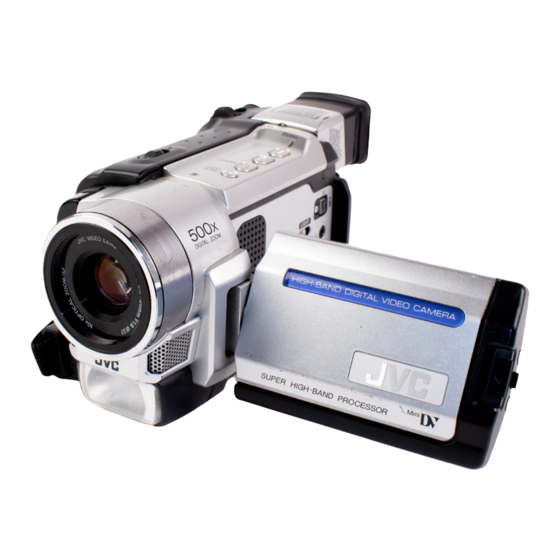
DIGITAL VIDEO CAMERA
GR-DVL867
GR-DVL865
GR-DVL767
GR-DVL765
GR-DVL567
GR-DVL367
GR-DVL365
GR-DVL167
GR-DVL160
Please visit our Homepage on the World Wide Web and
answer our Consumer Survey (in English only):
http://www.jvc-victor.co.jp/english/index-e.html
For Accessories:
http://www.jvc-victor.co.jp/english/accessory/
INSTRUCTIONS
CONTENTS
AUTOMATIC DEMONSTRATION
GETTING STARTED
TAPE
RECORDING & PLAYBACK
TAPE RECORDING ........................ 16 – 20
TAPE PLAYBACK .......................... 21 – 24
MEMORY CARD
RECORDING & PLAYBACK
MEMORY CARD RECORDING ......... 26 – 27
MEMORY CARD PLAYBACK ............ 28 – 29
ADVANCED FEATURES .................... 30 – 36
ADVANCED FEATURES
FOR RECORDING ........................... 38 – 45
USING MENUS FOR
DETAILED ADJUSTMENT .............. 46 – 51
DUBBING ..................................... 52 – 53
USING THE REMOTE CONTROL UNIT ... 54 – 64
SYSTEM CONNECTIONS .................. 65 – 66
REFERENCES
DETAILS ............................................. 68
TROUBLESHOOTING ...................... 69 – 73
USER MAINTENANCE ............................ 74
CAUTIONS .................................... 75 – 77
SPECIFICATIONS ........................... 78 – 79
INDEX ......................................... 80 – 86
TERMS ............................... 87 – Back Cover
The camcorder illustrations
appearing in this instruction
manual are of the
GR-DVL867.
Memory card recording
features are available on
GR-DVL867, GR-DVL865,
GR-DVL767, GR-DVL765,
GR-DVL567, GR-DVL367
and GR-DVL365
LYT0909-001B
ENGLISH
6
7 – 14
15 – 24
25 – 36
37 – 66
67 – Back Cover
EN
Advertisement
Chapters
Table of Contents

Related Manuals for JVC GR-DVL867


Summarization of Contents
Safety Precautions
General Safety Warnings
Important safety information to prevent hazards like fire, shock, and damage.
Environmental and Handling Cautions
Cautions regarding ventilation, water exposure, and handling the unit.
Handling and Carrying Precautions
Operational Safety Warnings
Warnings about handling the camcorder, including lens, cables, and operation by children.
Provided Accessories
Power and Battery Accessories
Details about the AC adapter and battery pack included with the camcorder.
Connection Cables and Other Accessories
Lists and describes various cables, remote control, and lens cap.
Attaching the Lens Cap
Step-by-step instructions for attaching the lens cap.
Automatic Demonstration Feature
Attaching Core Filters
Guide on attaching core filters to cables to reduce interference.
Cancelling Automatic Demonstration
Instructions on how to disable the automatic demonstration feature.
Getting Started: Power Management
Charging the Battery Pack
Step-by-step guide for charging the camcorder's battery pack.
Using AC Power
Instructions for powering the camcorder using the AC adapter.
Getting Started: Basic Setup
Camcorder Adjustments
Instructions for grip adjustment, viewfinder focus, and strap attachment.
Tripod Mounting
Guidance on safely mounting the camcorder onto a tripod.
Getting Started: Date and Time Settings
Setting the Camcorder Clock
Guide to setting the camcorder's internal clock and date.
Getting Started: Cassette Handling
Loading and Unloading a Cassette
Step-by-step instructions for handling video cassettes.
Getting Started: Recording Modes
Setting Tape Recording Mode
How to select between SP and LP recording modes for tape.
Getting Started: Memory Card Operations
Loading and Unloading Memory Cards
Instructions for inserting and removing memory cards.
Setting Picture Quality and Image Size
Guide to selecting image quality and size for memory card storage.
Tape Recording
Basic Recording Procedure
Step-by-step guide for basic video recording.
Adjusting Display Brightness
How to adjust the brightness of the LCD monitor display.
Tape Recording Modes and Operations
Journalistic Shooting and Self-Recording
Techniques for shooting oneself and different journalistic angles.
Camcorder Operation Modes
Explains Power Switch and VIDEO/MEMORY switch positions.
Tape Recording: Zooming Feature
Using the Zoom Lever
How to operate the zoom lever for magnification during recording.
Tape Recording: Video Light
Using the Video Light
Instructions for operating the video light for low-light shooting.
Tape Recording: Time Code
Understanding Time Code
Explanation of how time codes are recorded and used.
Recording from Middle of Tape
Method for resuming recording to avoid time code interruption.
Tape Playback Modes
Normal and Still Playback
Standard playback and pausing the tape for still images.
Shuttle and Frame-by-Frame Search
High-speed and frame-by-frame search functions during playback.
Connecting for Tape Playback
Connecting to TV or VCR (Standard)
Guide for connecting the camcorder to a TV or VCR using AV/S-Video cables.
Connecting with 21-pin Connector
Using a cable adapter for TVs/VCRs with a 21-pin SCART connector.
Tape Playback Display Options
Setting Connected TV Displays
Choosing which information (date/time, time code) appears on the TV.
Tape Playback: Blank Search
Finding Blank Portions on Tape
Using blank search to locate spots for recording.
Memory Card Recording
Basic Snapshot Shooting
Using the camcorder as a digital still camera for snapshots.
Memory Card Display Indicators
Explains icons and indicators related to image size and shots remaining.
Memory Card File Management
Protecting and Deleting Still Images
How to protect files from erasure and delete unwanted images.
Storable Image Capacity
Tables showing approximate number of images per memory card size.
Memory Card Playback
Normal and Auto Playback
Playing back images and E-MAIL CLIPs normally or automatically.
Memory Card Playback Notes
Notes on file compatibility, image display, and unsupported files.
Memory Card Playback Navigation
Index Playback
Viewing multiple files at once for easy selection.
Viewing File Information
Displaying details about selected image or clip files.
Removing On-Screen Display
How to hide or show on-screen indicators during playback.
Advanced Memory Card Features: File Protection
Protecting Files from Erasure
Steps to protect individual or all files on the memory card.
Removing File Protection
Instructions for removing protection from memory card files.
Advanced Memory Card Features: File Deletion
Deleting Files from Memory Card
How to delete files one by one or all at once.
Memory Card Deletion Cautions
Warnings about deleting files and handling the card during deletion.
Advanced Memory Card Features: Dubbing
Dubbing Still Images from Tape to Card
Copying still images from a tape onto a memory card.
Advanced Memory Card Features: E-Mail Clips
Making E-Mail Clips from Camera Image
Creating video clips from live camera feed for e-mail.
Making E-Mail Clips from Recorded Footage
Creating video clips from tape footage for e-mail.
Advanced Memory Card Features: Print Settings
Setting DPOF for All Still Images
Configuring the camcorder to print all still images with one print each.
Resetting DPOF Settings
How to reset the DPOF print settings to default.
Advanced Memory Card Features: Print Selection
Setting DPOF for Specific Images and Print Count
Selecting specific images and the number of prints for DPOF.
DPOF Setting Caution
Warnings about power disconnection during DPOF setup.
Advanced Memory Card Features: Organization and Formatting
Making a New Folder
Creating new folders to organize still pictures on the memory card.
Initialising a Memory Card
Formatting the memory card to clear all data.
Advanced Recording Features
Night-Scope Mode
Enhancing image brightness in dark conditions.
Programme AE with Special Effects
Using automatic exposure modes with creative effects.
Advanced Recording Features: Scene Effects
Shutter Speed and Sports Mode
Adjusting shutter speed for action shots and special effects.
Color and Lighting Effects
Using Sepia, Monotone, Snow, Spotlight, and Twilight effects.
Advanced Recording Features: Transitions
Fade and Wipe Effects
Adding professional scene transitions like fades and wipes.
Advanced Recording Features: Snapshot
Snapshot Mode Selection
Choosing modes for recording still images onto tape.
Snapshot Recording Procedure
How to take snapshots during recording or playback.
Advanced Recording Features: Focus Control
Auto Focus Operation
How the camcorder automatically focuses on subjects.
Manual Focus Operation
Steps for manually adjusting focus for precise control.
Advanced Recording Features: Exposure and Iris
Exposure Control
Adjusting exposure manually for challenging lighting conditions.
Iris Lock Function
Locking the iris setting to maintain exposure during subject movement.
Advanced Recording Features: White Balance
White Balance Adjustment
Adjusting color balance for accurate color reproduction under various lights.
Manual White Balance Operation
Steps for manually setting white balance using a white paper.
Using Menus for Detailed Adjustment
Recording Menu Options
Detailed explanation of settings within the recording menu.
Using Menus for Detailed Adjustment: Playback
Playback Menu Options
Detailed explanation of settings within the playback menu.
Dubbing Operations
Dubbing to a VCR
Connecting and dubbing footage from camcorder to VCR.
Digital Dubbing
Dubbing via DV Connector
Copying scenes using a DV connector for digital dubbing.
Remote Control Unit Operation
Installing Remote Control Batteries
Step-by-step guide for inserting batteries into the remote control.
Remote Sensor and Operation
Proper use of the remote sensor for distance operation.
Remote Control Functions
Remote Control Buttons and Operation
Explains buttons for playback, zoom, display, effects, and editing.
Remote Control Playback Features
Slow-Motion and Frame-by-Frame Playback
How to use the remote for slow-motion and frame-by-frame tape search.
Playback Special Effects via Remote
Applying visual effects to playback using the remote control.
Remote Control Playback Zoom
Magnifying Playback Images
Instructions for using the remote to zoom in on recorded images.
Random Assemble Editing (R.A.Edit)
Setting Remote Control for VCR
Pairing the remote control with a VCR using a code list.
Creating Edited Videos with R.A.Edit
Overview of creating edited videos using camcorder as source player.
R.A.Edit Connections and TV Output
Connecting for R.A.Edit
How to connect camcorder to VCR for editing using different connectors.
TV Display Options
Choosing what displays (date/time, time code) appear on the connected TV.
Random Assemble Editing Scene Selection
Selecting Scenes for Editing
Steps to select scenes, apply effects, and set edit points for R.A.Edit.
Automatic Editing to VCR
Executing Automatic Editing
Process for performing automatic editing of selected scenes to VCR.
Accurate Editing and Timing Adjustment
Diagnosing and Adjusting VCR/Camcorder Timing
Steps to diagnose and synchronize VCR and camcorder recording timing.
Audio Dubbing
Performing Audio Dubbing
How to add narration or sound to 12-bit recorded tapes.
Insert Editing
Recording New Scenes into Tapes
Replacing sections of original recording with new scenes with minimal distortion.
System Connections to Personal Computer
USB/PC Cable Connection
Connecting camcorder to PC via USB for still image transfer.
DV Cable Connection
Connecting camcorder to PC with a DV connector for image transfer.
Using Camcorder as a Webcam
Webcam Setup via USB
Using the camcorder as a webcam with USB connection and software.
Item Details and Notes
Power and Charging Details
Notes on charging conditions, adapter usage, and power interruption.
Tape Recording Details
Notes on LCD monitor visibility, cassette holder operation, and tape end indications.
Battery Information and Handling
Benefits of Lithium-Ion batteries and temperature considerations.
Troubleshooting Common Issues
Power, Date/Time, and Recording Problems
Solutions for power supply issues, date/time not set, and recording failures.
Picture and Focus Issues
Troubleshooting steps for no picture and automatic focus adjustment problems.
Troubleshooting Advanced Issues
Cassette, Memory Card, and Snapshot Problems
Solutions for cassette loading, memory card issues, and snapshot mode problems.
Color, Zoom, and Effect Issues
Troubleshooting for strange colors, digital zoom, and fade/wipe effects.
Troubleshooting Display and Data Issues
White Balance and Image Issues
Solutions for white balance activation, vertical lines, and screen color issues.
Date/Time and File Deletion Issues
Troubleshooting for missing date/time displays and memory card file deletion.
LCD Monitor Display Problems
Addressing dark or whitish LCD monitor images and causes.
Troubleshooting Monitor and Playback Issues
LCD Monitor and Viewfinder Issues
Solutions for hot LCD monitors, unclear indicators, and colored spots.
Sound and Playback Malfunctions
Troubleshooting for no sound during recording and distorted LCD images.
Troubleshooting Error Codes and Card Issues
Error Indications and Solutions
Explanations and corrective actions for error codes E01-E06.
Memory Card and Printer Issues
Troubleshooting for memory card removal problems and printer output issues.
User Maintenance and Cleaning
After Use Procedures
Steps to take after finishing camcorder use, including cassette removal.
Camcorder Cleaning Guide
Instructions for cleaning the lens, LCD monitor, viewfinder, and exterior.
Safety Cautions and Precautions
Video Light Safety
Warnings regarding the hot video light and its safe operation.
Battery Pack and General Battery Safety
Precautions for using battery packs, including hazards and service life.
Cassette Handling and Storage
Guidelines for properly using and storing Mini DV cassettes.
Handling and Storage Precautions
Memory Card Usage and Storage
Best practices for using and storing memory cards to prevent damage.
LCD Monitor and Main Unit Safety
Precautions to prevent LCD monitor damage and safety warnings for the main unit.
Media and Environmental Handling
CD-ROM Handling
Guidelines for handling and storing CD-ROMs to prevent damage.
Moisture Condensation Effects
Explains condensation phenomena and potential damage to the camcorder.
Camcorder Specifications
General Specifications
Details on power, dimensions, weight, operating conditions, and lens properties.
Pickup and Monitor Specifications
Details about the CCD pickup, lens, filter diameter, LCD monitor, and viewfinder.
Digital Still Camera and Connectivity Specifications
Digital Still Camera Functions
Specs for storage media, compression, file size, picture quality, and storable images.
Connectors and AC Adapter
Lists all available connectors and AC adapter specifications.
Index of Controls, Connectors, and Indicators
Camcorder Control Layout Diagram
Visual guide identifying numbered controls and parts on the camcorder.
Detailed Index of Camcorder Components
Controls and Buttons
Detailed list of camcorder controls and their function page references.
Connectors and Indicators
Information on connectors and key status indicators with page references.
Other Parts and Accessories
Identification of other parts like remote sensor, viewfinder, and grip strap.
Index of LCD/Viewfinder Indications
Tape Recording Indications
Explains symbols and indicators shown on screen during tape recording.
Memory Card Recording Indications
Explains symbols and indicators shown during memory card recording.
Index of Combined Recording Indications
Dual Mode Recording Indicators
Explains indicators active during both tape and memory card recording.
Index of Playback Indications
Tape Playback Indications
Explains symbols and indicators shown on screen during tape playback.
Memory Card Playback Indications
Explains symbols and indicators shown during memory card playback.
Warning Indications and Messages
Battery and Tape Warnings
Explains battery status, tape protection, and tape end warnings.
Operational and Format Warnings
Explains condensation, tape format, date/time, and audio dubbing warnings.
Index of Error and Memory Card Warnings
Editing and Memory Card Errors
Explains insert editing errors, memory full, copying failures, and card errors.
Unsupported Files and Unit Errors
Addresses unsupported files, protection switch errors, and unit safeguard modes.
Need help?
Do you have a question about the GR-DVL867 and is the answer not in the manual?
Questions and answers