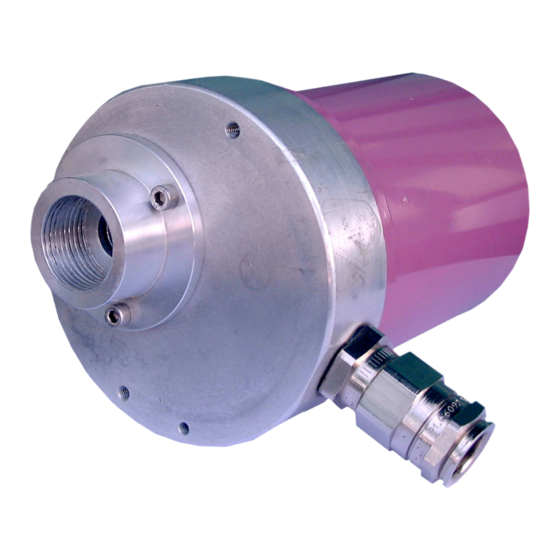
Honeywell C7061 A Product Handbook

Honeywell C7061 A Product Handbook

Dynamic self check ultraviolet flame detector
DYNAMIC SELF CHECK ULTRAVIOLET FLAME DETECTOR
model C7061A
model C7061F
APPLICATION
The C7061A is a dynamic self-checking flame detector for
sensing the ultraviolet radiation generated by the combustion
of gas, oil, or other fuels.
This flame detector is available in two versions:
model C7061A for use in Standard applications, and model
C7061F for use in installations requiring explosion-proof
packaging. The flame detector is designed for use with either,
R7061 Dynamic Self-Check Ultraviolet amplifier and
• R4348 Flame Switch or,
or with,
R7861A Dynamic Self-Check Ultraviolet amplifier and,
• 7800 SERIES Burner Programmers
These configurations provide a closed-loop, self-checking
circuit which insures the integrity of both amplifier and flame
detector. Improper response simulated flame loss results in
a safety shutdown and/or alarm.
Description .................................................................... 2
Features ......................................................................... 2
Orderdering information ................................................ 2
Specification .................................................................. 3
Standards and approvals .............................................. 4
Replacement parts and accessories ............................. 4
Dimensional drawing ..................................................... 5
Planning the installation ................................................ 6
Installation ..................................................................... 8
Wiring .......................................................................... 10
Adjustement and checkout ......................................... 12
Troubleshooting .......................................................... 13
Service ......................................................................... 14
1
C7061 A/F
PRODUCT HANDBOOK
CONTENTS
EN1C-0015SZ20 R0602
Table of Contents
loading

Frequently Asked Questions (13)

  • What are the common troubleshooting steps for a Honeywell C7061 A security sensor that is not responding?

    If your Honeywell C7061 A security sensor is not responding or showing an unsatisfactory flame signal, follow these troubleshooting steps:

    • Preliminary Inspection:
      • Check for the proper line voltage and ensure the master switch is closed, connections are correct, and the power supply is of the correct voltage and frequency.
      • Check the detector wiring for defects, including incorrect connections, wrong type or size of wire, deteriorated wire, open circuits, short circuits, and leakage paths caused by moisture, soot, or dirt.
      • With the burner running, check the temperature at the detector. If it exceeds 79°C (175°F), add additional insulation, add a shield or screen, or add cooling.
    • Procedure for a Zero Meter Reading (if the meter shows no reading):
      • Replace the plug-in amplifier, then recheck the flame signal.
      • Replace the ultraviolet sensing tube, then recheck the flame signal.
      • Replace the coil and shutter assembly, then recheck the flame signal.
      • If you still cannot obtain a meter reading, replace the detector.

    After completing troubleshooting, be sure to perform all necessary adjustments and checkout procedures.


    For more information, see page 13 of the manual.
    Was this helpful?
  • What is the recommended installation procedure for a Honeywell C7061 A motion sensor?

    The Honeywell C7061 A is a flame detector, not a motion sensor. The recommended installation procedure involves:

    • Planning the Installation: Ensure the detector is connected only to Honeywell-manufactured controls, disconnect power before installation, comply with NEC Class 1 wiring and local electrical codes, ensure voltage and frequency match detector values, sight the detector to avoid responding to ignition spark, and ensure each detector on multiburner installations responds only to its supervised flame. Do not connect more than two C7061A/F flame detectors in parallel.
    • Determining the Location: Install the detector where the ambient temperature remains within specified ratings, avoid excessive vibration, and ensure enough clearance for servicing.
    • Installing the Sight Pipe: Select a black iron pipe (1-1/2 to 3 inches diameter) and cut it to the desired length and angle. Tack weld the pipe to the combustion chamber wall in a trial position.
    • Preparing the Hole: Cut or drill a hole in the combustion chamber wall, flaring it to allow for small adjustments to the sighting angle.
    • Installing Fittings: Use reducers if the sight pipe is larger than the mounting flange. Consider ventilation for the sight pipe to cool the detector or clear the viewing path.
    • Mounting the Detector: Mount the detector onto the sight pipe, reducer, or other fitting. For C7061A/F models, align the notch and arrow indicators on the faceplate vertically, with the notch up and the arrow pointing down. The conduit opening should be approximately 45 degrees below horizontal.
    • Final Adjustments and Checkout: Perform all required adjustments and checkout tests after installation, including adjusting detector sighting and performing an ignition spark response test.
    Was this helpful?
  • What common factors cause a Honeywell C7061 A security sensor to trigger unexpectedly?

    The Honeywell C7061 A security sensor, a UV flame detector, can trigger unexpectedly due to:

    • Radiation sources other than flame: Examples include:
      • Radiant surfaces above 1200°C (2200°F).
      • Sparks from ignition transformers and welding arcs.
      • Gas lasers, Sun lamps, Halogen lamps, Germicidal lamps.
      • Incandescent lamps held close to the sensing tube.
      • Filament above 1200°C (2200°F).
      • Diffraction analyzers, Electron microscopes, Radiographic X-ray machines.
      • High voltage vacuum switches, High voltage condensers, Radioisotopes.
    • Screening effects: Masking agents like smoke, fuel mist, dirt, and dust can absorb ultraviolet radiation, reducing the flame signal and potentially causing a shutdown. This can be minimized by proper burner adjustment or increasing the detector viewing area.
    Was this helpful?
  • What is the optimal placement for a Honeywell C7061 A security sensor to maximize its effectiveness?

    To maximize the effectiveness of the Honeywell C7061 A security sensor, which is a UV flame detector, consider the following for optimal placement:

    • Temperature: Install the detector where the surrounding temperature will remain within the specified ambient operating temperature ratings. If the temperature rating is exceeded, cooling air will be necessary.
    • Vibrations: Avoid installing the detector where it could be subject to excessive vibration, as this shortens the life of electronic components. For vibrations greater than 1g, an anti-vibration mount is required.
    • Clearance: Ensure there is enough room to remove the detector's cover for servicing.
    • Basic Requirements: The detector must have an unobstructed view of the flame it is supervising under all firing conditions.
    • Sighting Angle: The best sighting angle is nearly parallel to the axis of the flame, aiming to view the first 30 percent of the flame (the root), which radiates the most intense ultraviolet energy. Tilting the detector and sight pipe downwards is desirable to prevent soot buildup.
    • Flame Response: The detector must be sighted to respond to the pilot flame alone, then the pilot and main burner flame together, and finally the main burner flame alone, and sight the most stable part of the flame for all firing rates.
    • Radiation Sources: Avoid installing the detector where it could be actuated by radiation sources other than flame, such as radiant surfaces above 1200°C, ignition sparks, or various lamps. If the flame relay pulls in due to these sources, re-aim the sight pipe to view a cooler area or decrease detector sensitivity.
    Was this helpful?
  • How do I calibrate a Honeywell C7061 A security sensor?

    To calibrate your Honeywell C7061 A security sensor, you need to:

    • Adjust the sighting position of the detector for optimum flame signal.
    • Use a volt-Ohm meter with a minimum sensitivity of one megohm/volt and a zero to five or ten Vdc scale to measure the flame signal.
    • Connect the positive (red) meter lead to the positive (+) control jack and the negative (black) meter lead to the negative (-) or (-Com) jack with 7800 SERIES controls.
    • Move the detector and sight pipe to view the flame from various positions and angles, aiming for a maximum steady (or stable) reading on the meter. The signal must be above the minimum acceptable voltage specified in Table 1.
    • Measure the flame signal for the pilot alone, the main burner flame alone, and both together (if applicable).
    • Also measure the flame signal at low and high firing rates and while modulating in between.
    • Ensure that all required flame signals are steady and as specified in Table 1 after the detector is in its final position.

    For more information, see page 12 of the manual.
    Was this helpful?
  • How do I safely open the casing of a Honeywell C7061 A motion sensor?

    The Honeywell C7061 A is a flame detector, not a motion sensor. To safely open its casing:

    • First, open the master switch to disconnect power.
    • For the C7061A model, unscrew the four captive cover screws and carefully slide off the cover. These bolts are removable, so place them in a safe location to avoid losing them.
    • For the C7061F model, carefully unscrew the cover from the detector cap.

    For more information, see page 14 of the manual.
    Was this helpful?
  • What is the correct method to remove a Honeywell C7061 A motion sensor from its wall mounting?

    The Honeywell C7061 A is a flame detector, not a motion sensor. To remove it from the sight pipe:

    • For the C7061A model:
      • Loosen the three screws holding the mounting flange together.
      • Rotate the detector slightly so the screws clear the slots in the back section of the flange.
      • Separate the flange and pull off the back section (with the UV Sensor).
    • For the C7061F model, carefully unscrew it from the sight pipe.

    For more information, see page 13 of the manual.
    Was this helpful?
  • Is the Honeywell C7061 A security sensor suitable for outdoor use?

    Yes, the Honeywell C7061 A security sensor is suitable for outdoor use as it meets IP66 enclosure requirements for outdoor protection, including being rain-tight, dust-tight, and hose-directed water.

    Was this helpful?
  • Does the Honeywell C7061 A security sensor have a self-test function?

    Yes, the Honeywell C7061 A security sensor has a self-test function. It utilizes an oscillating shutter that interrupts ultraviolet radiation 12 times per minute to provide a UV Sensor tube checking function. When used with the R4348 flame switch, the shutter frequency is 60 times per minute, and amplifier circuitry components are checked from the microprocessor in the 7800 SERIES Control. Malfunctions in the flame detection system result in a safety shutdown.


    For more information, see page 2 of the manual.
    Was this helpful?
  • How does temperature affect the performance of the Honeywell C7061 A security sensor?

    Temperature affects the performance of the Honeywell C7061 A security sensor in the following ways:

    • The sensor has specified ambient operating temperature ratings that must be adhered to for proper operation. For C7061A, this is -40°C to +70°C (-40°F to +160°F), and for C7061F, it's -20°C to +70°C (-22°F to +160°F).
    • To maintain the detector's temperature within specifications, if the temperature rating is exceeded, the introduction of cooling air will be necessary.
    • During troubleshooting, it's important to check the temperature at the detector. If it exceeds 79°C (175°F), you may need to add additional insulation, a shield to reflect radiated heat, or cooling to the sight pipe.
    Was this helpful?
  • How do I completely remove a Honeywell C7061 A motion sensor from my security system?

    The Honeywell C7061 A is a flame detector, not a motion sensor. To remove it from the sight pipe:

    • For the C7061A model:
      • Loosen the three screws holding the mounting flange together.
      • Rotate the detector slightly so the screws clear the slots in the back section of the flange.
      • Separate the flange and pull off the back section (with the UV Sensor).
    • For the C7061F model, carefully unscrew it from the sight pipe.

    For more information, see page 13 of the manual.
    Was this helpful?
  • What information is typically found in the Honeywell C7061 A security sensor datasheet?

    The Honeywell C7061 A security sensor datasheet typically includes information on:

    • Models (C7061A and C7061F specifications).
    • Ambient Operating temperature ratings.
    • Storage temperature ratings.
    • Voltage and Frequency.
    • Flame Signal characteristics.
    • Shutter frequency.
    • Pressure rating of quartz viewing window.
    • Dimensions.
    • Housing construction and color.
    • Enclosure ratings (e.g., IP66).
    • Weight.
    • Mounting and orientation.
    • Wiring Connections.
    • Serviceability of components.
    • Maximum cable length.
    • Design life of the ultraviolet sensing tube.

    For more information, see page 3 of the manual.
    Was this helpful?
  • What security certifications does the Honeywell C7061 A security sensor hold?

    The Honeywell C7061 A security sensor holds the following certifications and approvals:

    • EC-Directives: Conforms with:
      • Gas Appliance Directive (90/396/EEC), approved with R7861 and R7061 flame amplifiers.
      • Low Voltage Directive (73/23/EEC).
      • Electro Magnetic Compatibility Directive (89/336/EEC), including EN55011 class B (emission) and EN50082-2 (industrial level immunity).
    • Other Approvals (C7061A only):
      • Underwriters Laboratories Inc. Listed.
      • Canadian Standards Association Certified (Master File LR95329-1).
      • Factory Mutual Approved (14740.01).
      • Industrial Risk Insurers Acceptable.

    For the C7061F model, it also conforms with the Explosive Atmospheres Directive (94/9/EC).


    For more information, see page 4 of the manual.
    Was this helpful?
Need help?

Need help?

Do you have a question about the C7061 A and is the answer not in the manual?

Summary of Contents for Honeywell C7061 A

  • Page 1: Table Of Contents

    C7061 A/F DYNAMIC SELF CHECK ULTRAVIOLET FLAME DETECTOR PRODUCT HANDBOOK APPLICATION The C7061A is a dynamic self-checking flame detector for sensing the ultraviolet radiation generated by the combustion of gas, oil, or other fuels. This flame detector is available in two versions:...
  • Page 2: General Description

    GENERAL DESCRIPTION The C7061A1020 and C7061F1003 detector models are The terminal block on both models is of wire clamp type with identical except for housings. removable screws and is situated in the compartment of the Model C7061F detector is for use in installations requiring C7061.
  • Page 3: Technical Data Specification

    TECHNICAL DATA SPECIFICATION Color: Violet. Specification Mounting flange (with heat block) and faceplate are separate Models to provide heat insulation and seal-Off. C7061A: Self checking UV flame detector in standard C7061F: housing. Meets requirements (explosion-proof): EEx d IIC T6 C7061F: Self checking UV flame detector in explosion proof Construction: cast-aluminum Cover.
  • Page 4: Standards And Approvals

    STANDARDS AND APPROVALS Models C7061A and F Model C7061F C7061A and F Ultraviolet Flame Detector conform with In addition to above information, C7061F conforms with: following EC-Directives: • Explosive Atmospheres Directive (94/9/EC)“according to • Gas Appliance Directive (90/396/EEC).“according to European Standards:“EN50014“EN50018“EN50019 European Standard:“EN298 approved with R7861 and Other approvals (C7061A only) R7061 flame amplifiers.
  • Page 5: Dimensional Drawing

    DIMENSIONAL DRAWING Fig. 1. Dimensional drawing C7061A in inches (mm) Fig. 2. Dimensional drawing C7061F in mm EN1C-0015SZ20 R0602...
  • Page 6: Installation And Operation

    INSTALLATION AND OPERATION PLANNING THE INSTALLATION Proper flame detector application is the back of a safe and Determine the location reliable flame safeguard installation. Refer to the burner Before beginning the actual installation, estimate the best manufacturer’s instructions as well to those included here. location for mounting the detector based upon these factors: Follow all instructions carefully.
  • Page 7 IMPORTANT Multiburner requirements When installing the detector, make sure it does In multiple burner systems, not every detector can be not respond to ignition spark. positioned so its line of sight does not intercept flames from other burners. This situation occurs in front-fired boiler Single burner requirements furnaces having more than one row of burners, or in multilevel The detector must have an unobstructed view of the flame it...
  • Page 8: Installation

    INSTALLATION Mount Sight Pipe CAUTION Thread one end of the pipe to fit the mounting flange, union,or 1. lnstaller must be a trained, experienced flame required coupling. Cut the pipe to the desired length (as short safeguard control serviceman. as practical) and at an angle so it fits flush with the wall of 2.
  • Page 9 B Slightly rotate the detector so the slots in the back section of the mounting flange clear the screws in the front section; then separate the two sections. C Screw the front section of the mounting flange onto the sight pipe, reducer, or other fitting. Fig.
  • Page 10: Wiring

    WIRING CAUTION CAUTION When using a C7061A/F with an R7061 or R7861 When using the C7061 in conjunction with an Dynamic Self-Check amplifier, be careful not to R4348 flame relay at 230VAC, parallel sensores short the white shutter lead wires together (by can not be used.
  • Page 11 Fig. 10_3. Wiring diagram for C7061A1020/C7061F1003 Fig.10_4. Wiring diagram for C7061A1020/C7061F1003 detector with 7800 SERIES Flame Safeguard detector with R4348B Flame Safeguard controls controls with shutter drive circuitry. with shutter drive circuitry. EN1C-0015SZ20 R0602...
  • Page 12: Adjustement And Checkout

    ADJUSTMENTS AND CHECKOUT Adjust Detector Sighting Pilot Turndown Test With the flame detector installed and the burner running, If the detector is used to prove a pilot flame before the main adjust the sighting position of the detector for optimum flame fuel valve(s) can be opened, perform a pilot turndown test signal.
  • Page 13: Various Troubleshooting

    VARIOUS TROUBLESHOOTING CAUTION Preliminary lnspection A Check for the proper line voltage. Make sure the master 1. Be extremely careful while troubleshooting the switch is closed, connections are correct, and power detector; line voltage is present on some of supply is of the correct voltage and frequency. the terminals when power is on.
  • Page 14: Service

    SERVICE CAUTION Open the master switch to disconnect power before removing or installing the detector or its cover. More than one disconnect can be involved. Periodic Maintenance A Clean the viewing window (or focusing lens) when necessary. Remove the detector (see Troubleshooting section) and use a clean cloth over the eraser end of a pencil.
  • Page 15 Fig. 13. Replacing coil and shutter assembly. Replacing the Quartz Viewing Window (or Focusing Fig. 14. Replacing quartz viewing window or focusing lens Lens) C7061A Only IMPORTANT I Clean the viewing window (or focusing lens) on both sides A quartz window or lens must be used. Ordinary using a clean cloth placed over the eraser end of a pencil.
  • Page 16 Automation & Control Solutions Automation & Control Solutions Automation & Control Solutions Automation & Control Solutions Automation & Control Solutions Control Product Satronic AG Honeywell-Platz 1 CH-8157 Dielsdorf Phone: +41 1 855 22 11 Fax: +41 1 855 22 22 EN1C-0015SZ20 R0602...

This manual is also suitable for:

C7061 fC7061a1053

Table of Contents